
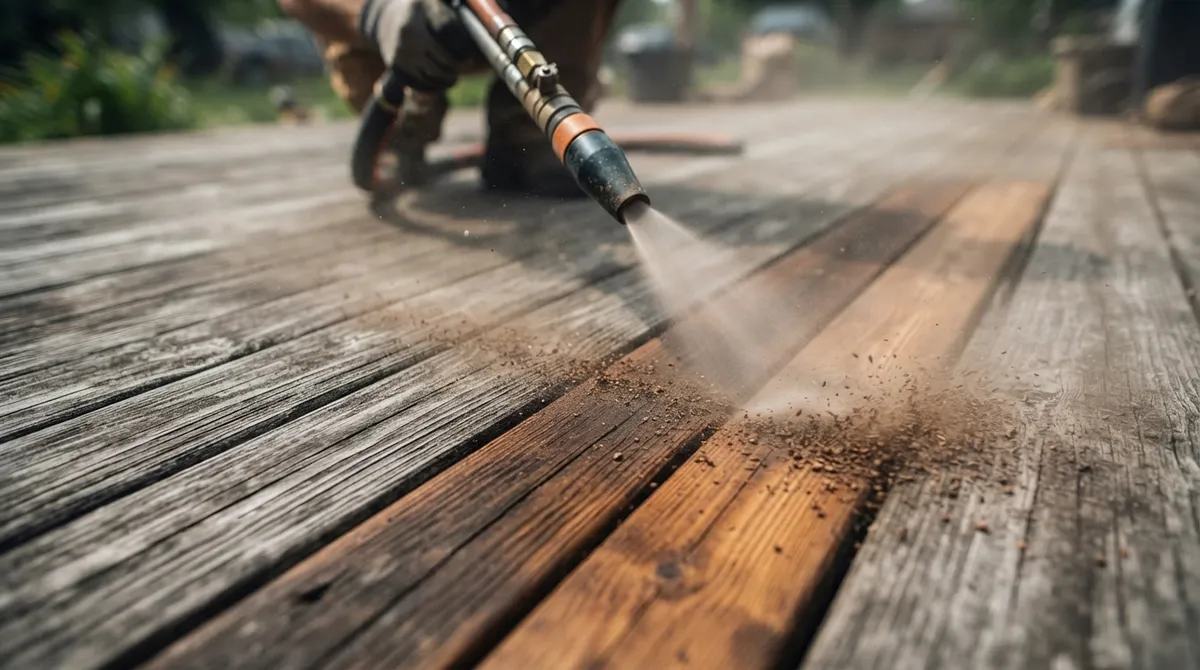
Key Takeaways
-
Use soft media like baking soda, crushed walnut shell, or corn cob instead of traditional silica sand, which gouges and fuzzes wood grain due to its hardness and sharpness.
-
Employ dustless blasting that mixes water into the blast stream to reduce heat buildup, prevent wood scorching, and control dust near pools or landscaping.
-
Always test a small hidden section first, start with low pressure, and work slowly in overlapping passes with the grain while checking progress frequently to avoid over-blasting.
-
Avoid blasting decks showing rot, structural weakness, thin boards, composite material, or extensive water damage; sometimes replacing a few boards first is better than attempting restoration.
-
Media blasting outperforms hand sanding and pressure washing alone by reaching grooves and trim work while removing coatings evenly and consistently without raising wood grain or pushing water into boards.
-
Choose an experienced operator who inspects for soft spots before starting and treats wood differently than metal, since wood grain has soft and hard bands that react differently to blasting pressure.
You look out at your deck and sigh. The wood used to be beautiful, but now it’s gray, blotchy, and covered in old stain that just won’t let go. Someone told you sandblasting could strip it clean in an afternoon. Someone else warned you it will tear your deck apart. So which is true? The honest answer is: it depends entirely on how the job is done.
Here at Blastworx, we hear this question all the time from folks around Tampa Bay and the central Florida corridor. And we get why people are nervous. Wood is not like metal or concrete. It’s soft, it has grain, and it can absorb damage that you won’t notice until it’s too late. But with the right approach, sandblasting (or more accurately, media blasting) can safely bring an old wood deck back to life. Let’s walk through exactly how that works, and where things can go wrong if the wrong method gets used.
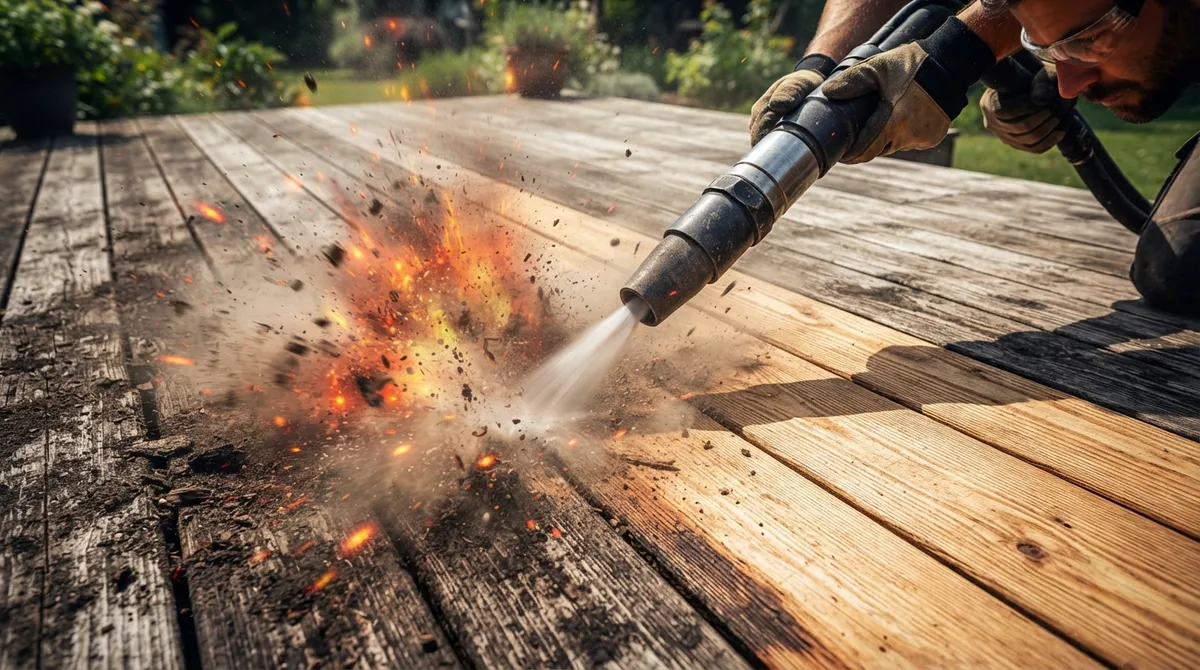
Can You Sandblast a Wood Deck Without Damaging It?
Yes, but only if the person doing it treats your deck like wood, not like a steel beam. Traditional hard sand at high pressure is a fast way to gouge, fuzz, and eat into a deck board. That’s the version of “sandblasting” that gives the whole process a bad reputation.
The safer path is what most professionals call media blasting or dustless blasting. Instead of blasting wood with the same abrasive you’d use on rusty steel, we switch to softer materials and lower pressure. This lets us strip away the old finish without cutting into the wood underneath. It’s a completely different experience than what people picture when they hear the word “sandblasting.”
Why Wood Behaves Differently Than Metal or Concrete
Wood has a grain, and that grain has soft and hard bands running through it. Blast it too hard, and the blasting media chews away the soft parts faster than the hard parts. This is called “fanning” or “feathering,” and it leaves a wavy, uneven texture on the surface.
Metal doesn’t have this problem, because it’s uniform all the way through. That’s why the same settings that work great on a rusty railing can wreck a cedar deck board in seconds. Matching the media and pressure to the material is the whole game here, which is something we talk about often in our 12 Facts: Does Sandblasting Damage Wood? guide.
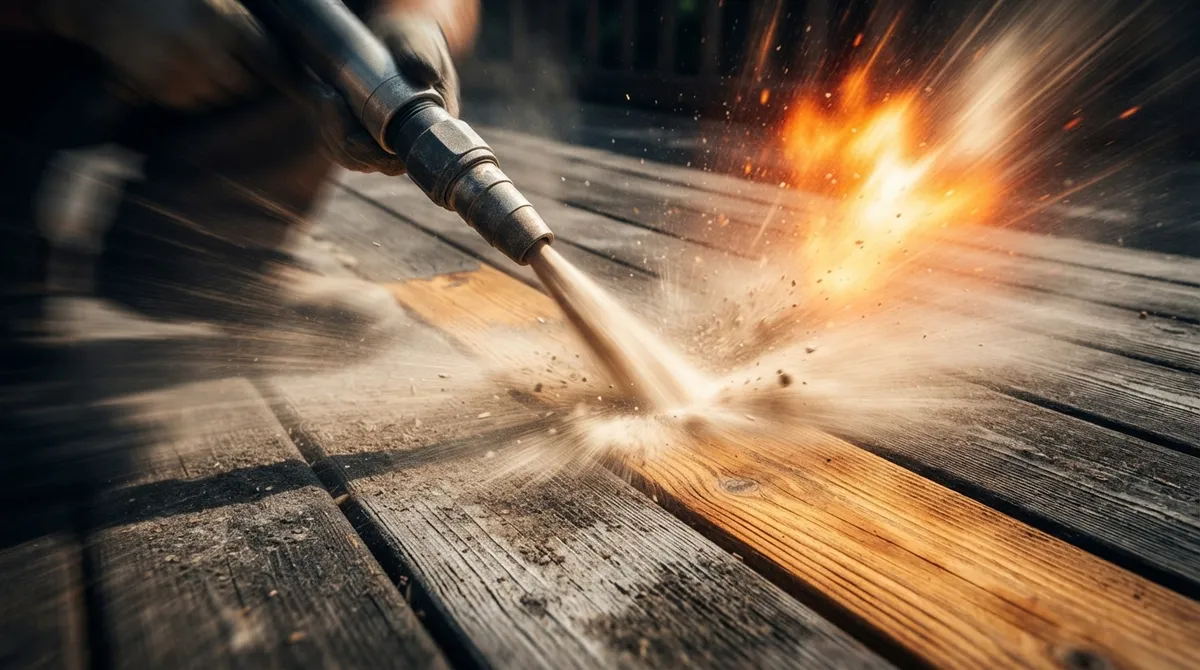
The Best Media for Blasting a Wood Deck
Not all blasting media is created equal, and picking the wrong one is the number one reason decks get damaged. Here’s a quick look at what’s typically used and why.
| Blasting Media | Best Use on Wood | Risk Level |
|---|---|---|
| Baking Soda | Removing paint, mildew, light stains | Low |
| Crushed Walnut Shell | Stripping old finishes, gentle cleaning | Low |
| Corn Cob Media | Delicate surfaces, log cabins, trim | Low |
| Crushed Glass | Faster stripping on harder woods | Medium |
| Traditional Silica Sand | Not recommended for wood decks | High |
Notice that traditional sand sits at the bottom of that list for a reason. It’s sharp, hard, and unforgiving on a soft material like wood. Baking soda, walnut shell, and corn cob are all softer and break down the coating without attacking the wood fibers underneath.
Why Dustless Blasting Adds an Extra Layer of Protection
Dustless blasting mixes water into the blast stream along with the abrasive. This does two helpful things for a wood deck project.
- It keeps dust down, which matters if your deck is near a pool, garden, or your neighbor’s yard.
- It reduces heat buildup on the wood surface, lowering the chance of scorching or drying out the grain.
- It helps the old paint or stain lift away more evenly, since moisture softens the coating slightly.
- It’s easier on landscaping and nearby surfaces since less material goes airborne.
If you’ve read our post on what makes dustless blasting in Tampa so effective, you know this method has become a favorite for outdoor residential work, and decks are a perfect example why.
Steps a Professional Follows to Blast a Deck Safely
There’s a method to this. Skipping steps is usually where trouble starts. Here’s the general sequence a careful operator follows.
- Inspect the deck for soft spots, rot, or loose boards before starting.
- Choose a soft media, like soda or walnut shell, based on the wood type and coating.
- Test a small, hidden section first to check how the wood reacts.
- Set the pressure low, then adjust gradually if needed.
- Blast in even, overlapping passes, moving with the grain.
- Check progress often to avoid over-blasting any single spot.
- Clean up all residue and inspect the finished surface for consistency.
This isn’t a race. Rushing through a deck with high pressure just to finish faster is exactly how gouges and uneven patches happen. A patient operator moves slowly and checks the wood constantly.
Signs a Deck Was Blasted the Wrong Way
If you’ve ever seen a deck with a strange, wavy texture or spots that look almost “hairy,” that’s blast damage. Here’s what to watch for.
- Fuzzy or raised wood grain that feels rough to the touch
- Uneven color where some boards look lighter or more worn than others
- Visible grooves or gouges running across the boards
- Splintering along the edges of deck boards
- Soft, spongy spots where too much material was removed
None of these are things you want to discover after the job is done. That’s why choosing an experienced operator matters just as much as the equipment they use.
Sandblasting vs Sanding: Which Is Better for a Deck?
People often ask if hand-sanding is the safer choice. It can be, but it comes with its own tradeoffs. Here’s a simple comparison.
| Factor | Media Blasting | Hand Sanding |
|---|---|---|
| Speed | Fast, covers large areas quickly | Slow, especially on big decks |
| Reaches Grooves and Corners | Yes, gets into tight spots easily | Difficult, often missed |
| Risk of Damage | Low, if done correctly | Low, but inconsistent results |
| Dust and Mess | Controlled with dustless methods | Significant dust from sanders |
| Physical Labor | Minimal for the homeowner | High if doing it yourself |
Media blasting tends to win on speed and consistency, especially for decks with railings, spindles, or detailed trim work that a sander just can’t reach well. For more on why blasting often outperforms manual methods, take a look at our article on blasting vs hand tools, which covers many of the same principles that apply to wood.
What About Pressure Washing Instead?
Pressure washing alone often isn’t enough for a deck with old paint or thick stain buildup. It can raise the wood grain, push water into the boards, and still leave patches of old coating behind. Blasting removes the coating at the surface level instead of just blasting water into the wood, which is a big part of why it’s often the better long-term choice, similar to what we discuss in sandblasting vs pressure washing for concrete.
Why Mobile Blasting Works So Well for Deck Restoration
Your deck isn’t going anywhere, so bringing the equipment to it just makes sense. That’s the whole idea behind mobile blasting. Trailer-mounted or skid-mounted rigs travel directly to your home, whether you’re in Tampa, Clearwater, Ocala, Orlando, or Fort Myers.
The global mobile sandblasting market was valued at roughly USD 0.6 billion in 2024, and a big part of that growth comes from exactly this kind of on-site residential work. Homeowners want their deck restored without hauling boards to a shop, and mobile crews make that possible.
At Blastworx, we come to you with a fully mobile and self-contained rig. We don’t need your power or water hookups, and we protect the surrounding area, pool, landscaping, and windows before we ever start blasting. We match the blast to your surface, not the other way around, which means your deck gets the gentle treatment it deserves while your railings or metal fixtures might get a stronger touch if needed.
What Blastworx Looks at Before Blasting a Deck
Every deck is a little different, so we don’t use a one-size-fits-all approach. Here’s what we consider before we ever fire up the rig.
- Type of wood (pressure-treated pine, cedar, redwood, composite, etc.)
- Age and condition of the current coating or stain
- Presence of mildew, algae, or water damage
- Whether the deck has decorative trim or spindles that need extra care
- Nearby surfaces like pools, screens, or landscaping that need protection
This is part of our four-step process. We start with a walkthrough, either in person or with photos, so we can figure out the right media for your specific deck. Then we provide a free estimate the same day. If you want to see how this looks for other outdoor living spaces, check out our page on residential blasting services.
When a Wood Deck Might Not Be a Good Candidate
Blasting isn’t always the right call. Sometimes a deck is too far gone or too fragile for even gentle media blasting. Here are situations where caution is needed.
- The wood shows signs of rot, decay, or structural weakness.
- Boards are already thin or splintering badly.
- The deck is composite material rather than real wood.
- There’s extensive water damage underneath the surface.
- The deck has already been over-blasted in the past.
An honest operator will tell you upfront if your deck isn’t a great fit for blasting. Sometimes replacement of a few boards makes more sense before restoring the rest. This kind of straightforward assessment is part of what builds trust, and it’s why we always encourage people to see what our Tampa Bay customers are saying about us on Google before making a decision.
Getting Your Deck Ready for the Next Step
Once blasting is done, your deck isn’t finished, it’s ready to finish. That means it’s clean, bare wood, ready for stain, sealer, or paint. Blasting handles the strip and prep work, but refinishing is generally handled by you or your painter, since coating choice comes down to personal preference and local climate needs.
Florida’s humidity and sun make sealing pretty important once the old coating is gone, so don’t wait too long after blasting to get a fresh protective layer down. For more general background on the blasting process itself, the what is sandblasting overview on Wikipedia is a solid starting point if you want the technical side of things.
A Quick Recap of What Makes Deck Blasting Safe
Let’s bring it all together with the core principles that keep a wood deck safe during blasting.
- Use soft media like soda, walnut shell, or corn cob instead of hard sand
- Keep pressure low and adjust based on the wood’s reaction
- Consider dustless blasting to reduce heat and dust
- Always test a hidden section before blasting the whole deck
- Work with someone experienced in wood specifically, not just metal or concrete
When these steps are followed, blasting becomes one of the fastest and most effective ways to restore a tired old deck, without turning it into a splintered mess.
Ready to Bring Your Deck Back to Life?
Your deck has a lot of life left in it, it just needs the right care to bring that back out. If you’re anywhere in Tampa Bay, Ocala, Orlando, Fort Myers, or the towns in between, we’d love to take a look and give you a straightforward, honest opinion. Reach out today to get a free estimate, or if you’d rather just talk it through, give us a call and we’ll walk you through exactly what your deck needs.
FAQs
Q: Can you sandblast a wood deck without ruining the wood?
A: Yes, as long as the operator uses a soft media like soda or walnut shell and keeps the pressure low. It’s really about matching the technique to the wood, not blasting it like you would a piece of steel.
Q: What blasting media is safest for a wood deck?
A: Baking soda, crushed walnut shell, and corn cob media are the gentlest options for wood. Traditional silica sand is too harsh and tends to gouge or fuzz the grain, so it’s best avoided on decks.
Q: Is dustless blasting better than sandblasting for wood decks?
A: For most decks, yes. Dustless blasting mixes water into the process, which cuts down on dust and helps prevent heat buildup, so it’s often gentler and cleaner overall.
Q: How much pressure should be used when blasting a wood deck?
A: Low pressure is the name of the game here. A good operator starts light, tests a hidden spot first, and only adjusts up if the wood is holding up well.
Q: Will blasting remove stain and paint from a deck evenly?
A: When it’s done correctly with the right media, yes, blasting strips old coatings evenly across the whole surface. Uneven results usually come from rushing the job or using the wrong abrasive.





