Key Takeaways
-
Dry abrasive blasting is the go-to for heavy rust, mill scale, and thick coatings because it removes them fast and leaves the anchor profile that primers and protective coatings need.
-
Soda blasting is much gentler, making it a better choice for thin or delicate metal like body panels and light-gauge parts, where dry media could warp the substrate.
-
Choose the blasting method based on the metal, the rust or coating thickness, and the next coating step, and consider using both methods on one project if needed.
-
Check the project spec or coating manufacturer for the required cleanliness grade (such as SSPC-SP 10 or SP 6) and get it in writing before work starts, since these grades are not interchangeable.
-
Prime and coat bare steel soon after blasting, because flash rust can form quickly in humid, salty conditions like Florida's and can compromise coating adhesion.
-
Blasting produces dust that may include silica or lead from old coatings, so use silica-free media where possible, test old coatings, and contain the work area to protect people and property.
Rust on a trailer frame. Old paint peeling off a gate. A boat hardware set that has seen better days. If you have ever stared at a metal surface and wondered how to get it clean, you are not alone. The big question is usually the same: which blasting method is right for the job?
Metal surface blasting is a prep process. Abrasive media is propelled at the metal to remove rust, mill scale, old coatings, and buildup. It also leaves a surface profile that helps new coatings stick. A coating is only as good as the surface underneath it, so this step matters a lot.
In this guide, we compare two popular approaches for metal: dry abrasive blasting and soda blasting. We will cover what each does well, where each falls short, and how to pick. We will also touch on cleanliness grades, safety, and timing. Let’s get into it.
What Metal Surface Blasting Actually Does
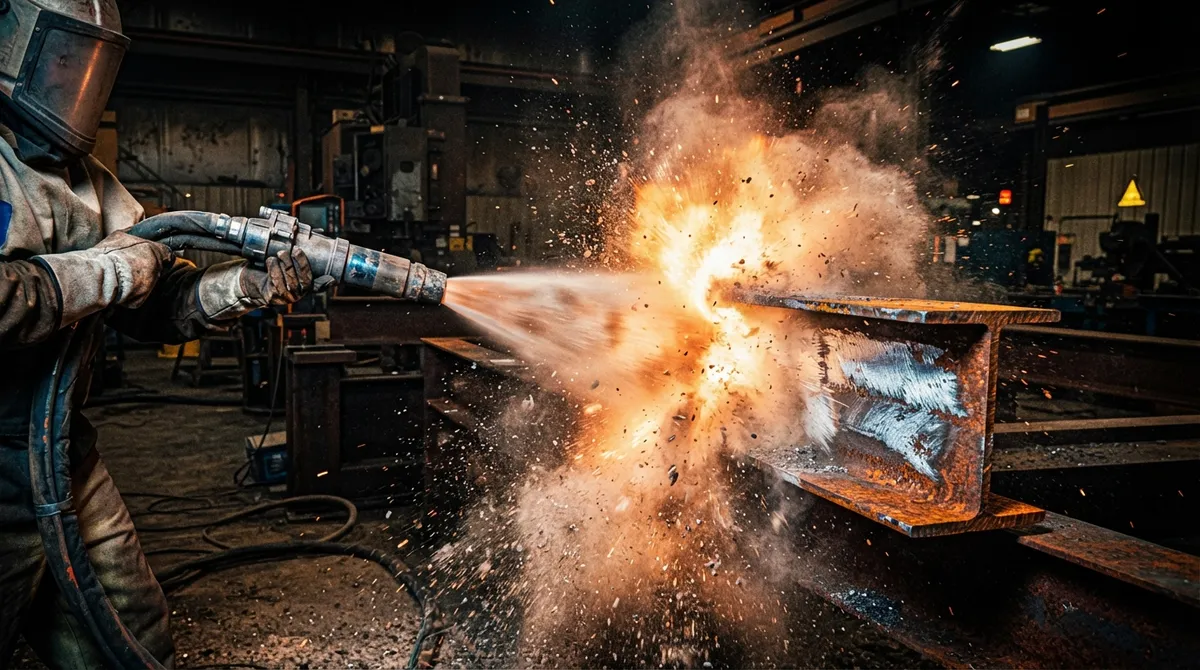
Metal surface blasting takes a surface back to clean, sound material all at once. Hand-sanding and wire brushes often miss rust in seams, corners, and pits. Blasting reaches those spots fast.
The process also creates a surface profile. That is a tiny pattern of peaks and valleys in the metal. Paint, powder coat, and primer grip that pattern. Without it, coatings can peel early, especially in Florida’s heat, humidity, and salt air.
The coating system or project spec should set the cleanliness and profile you need. Not every job needs bare, shiny steel. Some only need loose rust and paint knocked off. Knowing the target first saves time and money.
Mobile Blasting: Why It Fits Metal Work
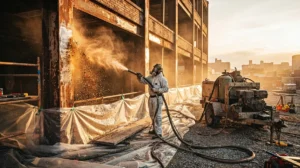
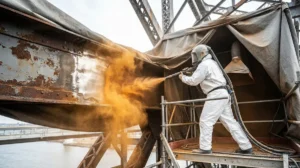
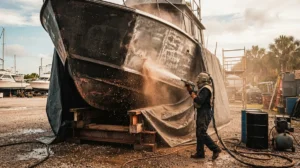
Many metal items are big, fixed, or hard to move. Think structural steel, tanks, trailers, machinery, and boat hardware. Hauling them to a shop can cost more than the blasting itself.
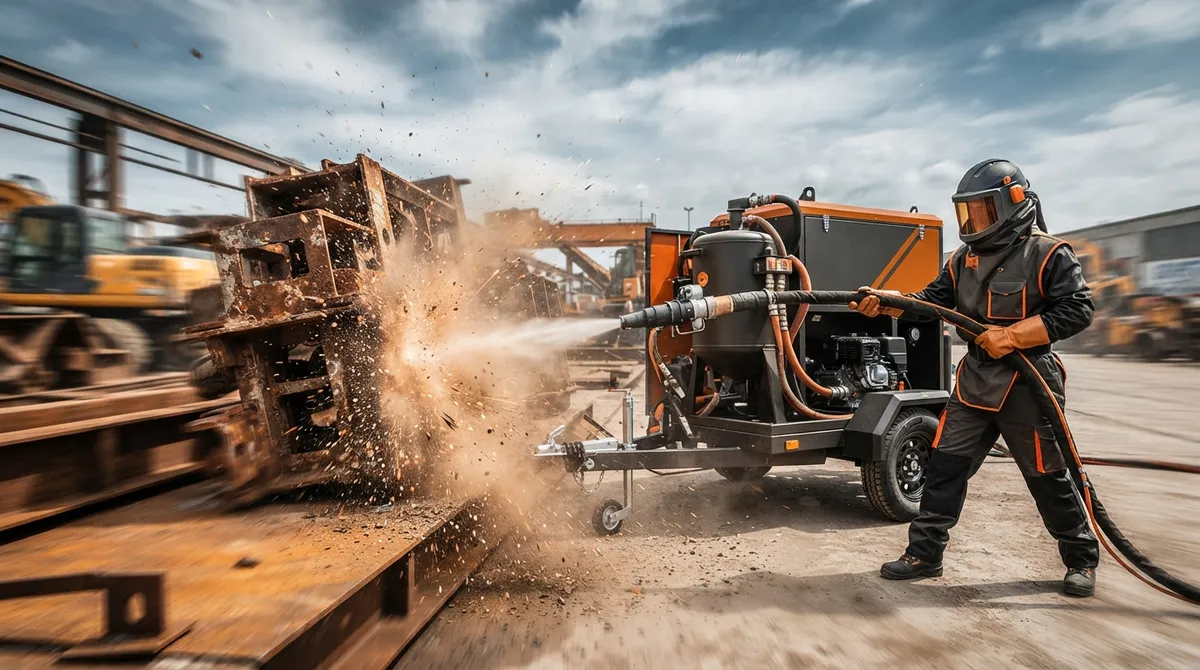
Mobile blasting flips that. We come to you. Our rig is fully mobile and self-contained, so we work dockside, in a driveway, at a shop, or on a job site without needing your power or water. You can see more about how this compares in our guide on mobile rig vs. drop-off shop.
Site details still matter. Access, weather, nearby people, and nearby property all affect setup. A good crew plans for containment before the first blast.
Dry Abrasive Blasting for Metal
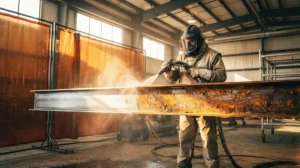
Dry abrasive blasting uses compressed air to fire hard media at the surface. It is the classic choice for heavy rust, thick coatings, and mill scale. It also gives the strongest profile for coatings.
Where Dry Blasting Shines
- Heavy rust: Frames, trailers, fences, and structural steel clean up quickly.
- Thick or stubborn coatings: Old epoxy, multiple paint layers, and scale come off fast.
- Profile creation: It leaves the anchor pattern that primers and protective coatings need.
- Large surface areas: It covers a lot of ground in a short time.
Where Dry Blasting Needs Care
Hard media can warp thin metal if the pressure or angle is wrong. It also creates more dust, so containment matters. Media choice is key here. Silica-free options like garnet and steel abrasives are common picks, and the right one depends on the substrate, the coating, and the profile you want.
We match the blast to your surface, not the other way around. That means picking the right media for the job, not just whatever is on hand. For a deeper look at the basics, see how metal surface preparation blasting really works.
Soda Blasting for Metal
Soda blasting uses baking soda media. It is much gentler than dry abrasives. The soda breaks on impact and lifts coatings and grime without cutting deep into the metal.
Where Soda Blasting Shines
- Thin or delicate metal: Body panels and light-gauge parts are less likely to warp.
- Light coating and grime removal: It works well on old paint, grease film, and surface buildup.
- Mixed-material parts: It can be a good fit near rubber, chrome, glass, or fiberglass.
- Low heat: Cooler blasting helps protect sensitive pieces.
Where Soda Blasting Falls Short
Soda does not create much of a profile. It also is not the best tool for heavy rust or thick mill scale. If your next step is a high-performance protective coating, soda alone may not give the grip you need. Soda residue also needs to be dealt with before coating, so cleanup and inspection are part of the plan.
Curious whether it fits your job? Read how to choose between soda blasting vs sandblasting.
Side-by-Side Comparison
| Factor | Dry Abrasive Blasting | Soda Blasting |
|---|---|---|
| Best for | Heavy rust, thick coatings, mill scale | Light coatings, grime, delicate metal |
| Surface profile | Strong anchor pattern | Little to none |
| Risk to thin metal | Higher if pressure is wrong | Lower |
| Rust removal | Excellent | Limited |
| Dust and debris | More dust, needs strong containment | Less aggressive, still needs cleanup |
| Typical metal jobs | Trailers, frames, structural steel, gates | Body panels, hardware, light-gauge parts |
| Next step | Prime and coat | Clean-up, then refinish as needed |
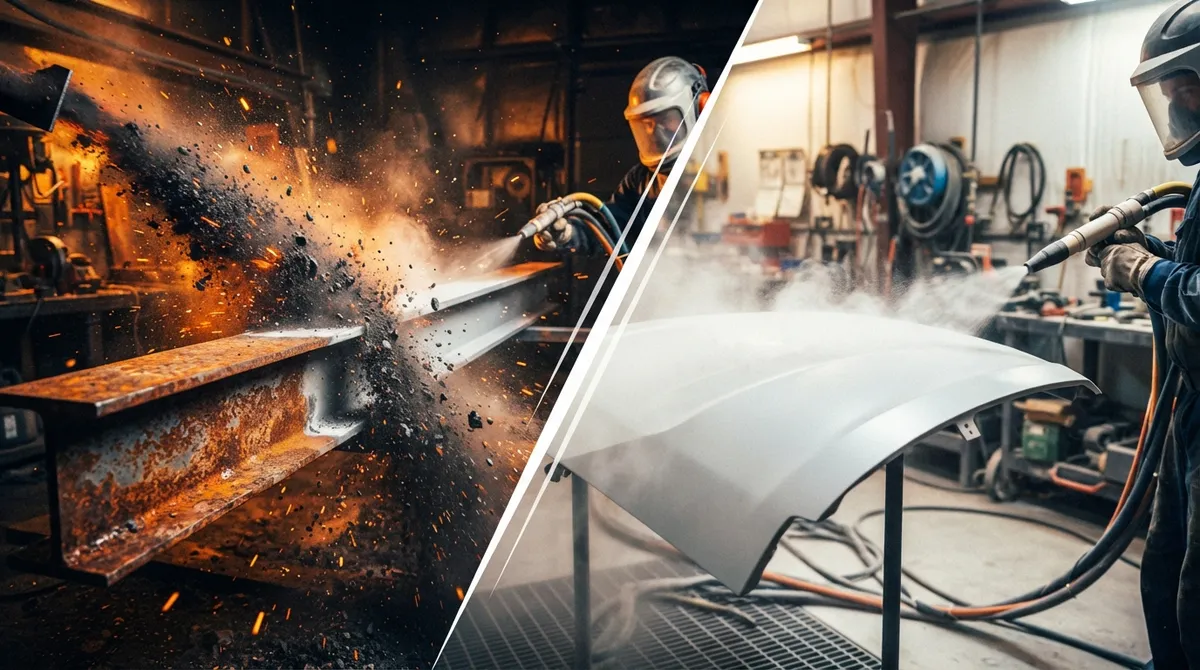
Notice how neither one “wins” every time. The better pick depends on the metal, the coating, and the finish you want. Sometimes a crew uses both on the same project: stronger media on the frame, softer media on the thin panels.
Understanding Cleanliness Grades
If you have ever read a coating spec, you have seen codes like SP 10 or Sa 2½. These are cleanliness grades for blast-cleaned steel. Here is a quick plain-English look at the common dry-blast grades:
- SSPC-SP 5 / NACE No. 1 (white metal): Surface looks completely clean, with no visible rust, scale, or coating.
- SSPC-SP 10 / NACE No. 2 (near-white metal): Almost as clean, with only very light staining allowed.
- SSPC-SP 6 / NACE No. 3 (commercial): Most rust and coating gone, with more staining allowed.
- SSPC-SP 14 / NACE No. 8 (industrial): Tightly bonded residue may remain in set amounts.
- SSPC-SP 7 / NACE No. 4 (brush-off): Loose material removed only.
ISO 8501-1 uses grades like Sa 2, Sa 2½, and Sa 3. Do not treat ISO and SSPC/NACE grades as perfect matches. The project spec and the coating maker decide what is required. When in doubt, ask for the grade in writing before work starts.
Safety and Containment Matter
Blasting makes dust. That dust can come from the media and from what you are removing, like old paint or rust. OSHA points to risks such as respirable crystalline silica and toxic metals like lead. Its silica permissible exposure limit is 50 micrograms per cubic meter as an 8-hour average, with an action level of 25 (29 CFR 1910.1053). Always confirm what applies to your worksite.
Good crews plan for this before work starts. Common controls include:
- Picking silica-free media where possible
- Checking old coatings for hazardous content
- Containing the work area to protect people and property
- Using proper ventilation and respiratory protection
- Handling and disposing of spent media the right way
We contain the mess and protect the surrounding area, whether that is a dock, a driveway, or an active job site. Dustless blasting is also available for indoor work and areas near other equipment. Learn more in how pros handle sandblasting dust control safely.
Prep Before and Timing After
Blasting does not fix everything on its own. Oil and grease should be removed before blasting, or they can get pushed into the metal. After blasting, the surface should be checked for dust, cleanliness, and profile.
Timing matters too. Bare steel can flash rust fast in Florida’s humidity. Moisture, salts, and long delays before coating can hurt how well paint holds. Plan so the surface is ready to prime and coat soon after blasting. Our 14 surface prep steps before commercial coating covers this in more detail.
One note on scope: at Blastworx, we strip and prep. Coating is handled by you, your painter, or your coating crew. For some industrial jobs, protective coating may be available when needed.
How to Choose the Right Method
Here is a simple way to decide. Ask yourself these questions:
- What is the metal? Thick structural steel can take stronger media. Thin body panels need a gentler touch.
- How heavy is the rust or coating? Heavy buildup points toward dry abrasive. Light paint and grime may suit soda.
- What goes on next? Protective coatings often need a profile. That favors dry blasting.
- What is nearby? Chrome, glass, fiberglass, or active equipment may call for softer or dustless options.
- What does the spec say? If a cleanliness grade is required, follow it.
If you are still unsure, compare the broader approaches in blasting vs. hand tools. Our automotive and marine crews also see this choice daily. You can read about our automotive blasting, marine blasting, and industrial blasting services to see how media choice changes by project.
How Our Process Works
We keep it simple, and you talk to the people doing the work:
- Walkthrough. Send photos or we come look, and we figure out the right media for the surface.
- Free estimate. A clear, written estimate the same day. The price we give is the price you pay.
- Blast and strip. We protect the surrounding area, then blast the surface clean at your location.
- Ready to finish. The surface comes out clean and ready for the next step.
We are owner-operated and fully insured. We serve Tampa, Clearwater, Sarasota, Ocala, Orlando, and Fort Myers, plus towns like Brandon, Riverview, and Plant City. Check our service areas and browse the gallery to see real results. You can also visit us on Google and see what our customers are saying about us.
New to the whole idea? Here is a quick refresher on what is sandblasting and where the term comes from. And for worker safety guidance, OSHA offers a helpful publication on protecting workers from the hazards of abrasive blasting. For more on standards, the AMPP page on surface prep standards is a good read.
The Bottom Line
Dry blasting is the go-to for heavy rust, thick coatings, and strong profile. Soda blasting is the gentle choice for thin or delicate metal and light coating removal. The best answer is the one that matches your metal, your coating plan, and your site. Many projects use a mix.
Ready to get your metal back to clean, bare metal and ready for the next step? Get a free estimate today, or give us a call at 813-380-8092. You can text us, too. We come to you.
FAQs
Q: What is metal surface blasting, and how does it prepare steel for painting?
A: Metal surface blasting fires abrasive media at steel to remove rust, scale, and old coatings. It also leaves a fine surface profile that helps primer and paint grip. That is why a blasted surface holds coatings far better than a hand-sanded one.
Q: What surface-preparation grade should I specify for metal blasting?
A: It depends on your coating system and project spec, so check those first. Common dry-blast grades include SSPC-SP 6 (commercial), SP 10 (near-white), and SP 5 (white metal). These grades are not interchangeable, so get the required one in writing.
Q: Can mobile blasting be done on-site without damaging nearby property?
A: Yes, with good planning. We protect the surrounding area, contain the work zone, and pick media that fits your surface. Dustless blasting is also available for indoor work or areas near other equipment.
Q: How soon after blasting should metal be primed or painted?
A: As soon as practical. Bare steel can flash rust quickly in Florida’s humidity, and moisture or salts can hurt coating performance. Plan your painter or coating crew so the surface is ready to prime soon after blasting.
Q: Is abrasive blasting safe when removing lead paint or rust?
A: It can be, but only with the right controls. Old coatings may contain lead or other toxic metals, and some media can create silica dust. Testing, containment, ventilation, proper respiratory protection, and correct waste handling all matter, and rules vary by site.