
Key Takeaways
-
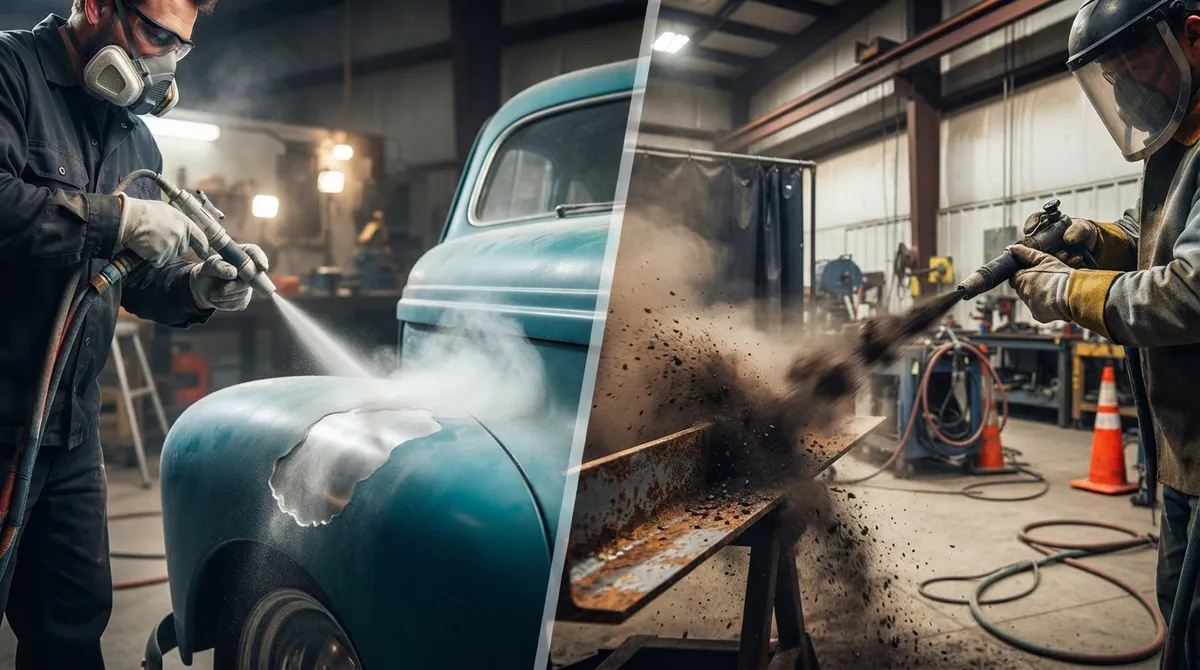
Soda blasting uses soft sodium bicarbonate to gently remove paint without damaging delicate surfaces, while abrasive blasting (garnet, aluminum oxide, steel grit) handles heavy rust and mill scale but requires proper surface profile creation for coating adhesion.
-
Real silica sand is no longer used professionally due to silicosis risks; OSHA limits respirable crystalline silica to 50 micrograms per cubic meter, so responsible companies use silica-free alternatives like crushed glass or garnet.
-
Soda blasting excels at automotive restoration, fire damage cleanup, graffiti removal, and fiberglass boats because it lifts contaminants without gouging, and sodium bicarbonate dissolves in water for easier cleanup.
-
Soda blasting alone cannot create an anchor profile on steel needed for paint adhesion, so structural steel typically requires stronger abrasives or a follow-up abrasive pass after initial soda blasting.
-
Always perform a test blast on a small, hidden area before full production to prevent costly damage, especially on soft metals, wood, fiberglass, and masonry that require careful pressure adjustment.
-
Both blasting methods require dust control and proper PPE; old coatings may contain hazardous materials like lead, so assess what’s being removed and follow OSHA guidelines regardless of media type used.
Staring at a rusty gate, an old boat hull, or a paint-covered fence and wondering which blasting method will actually work? You’re not alone. This is one of the most common questions we hear from folks across Tampa Bay, and honestly, it’s a great question to ask before you commit to a project. The right choice can save you time, money, and a whole lot of headache.
Here’s the good news: you don’t need to be a blasting expert to make a smart decision. You just need to understand a few key differences. In this guide, we’ll walk you through what soda blasting and sandblasting actually do, when each one shines, and how to figure out which fits your project. By the end, you’ll feel confident talking to a contractor or even tackling the decision yourself.
What Is Soda Blasting vs Sandblasting, Really?
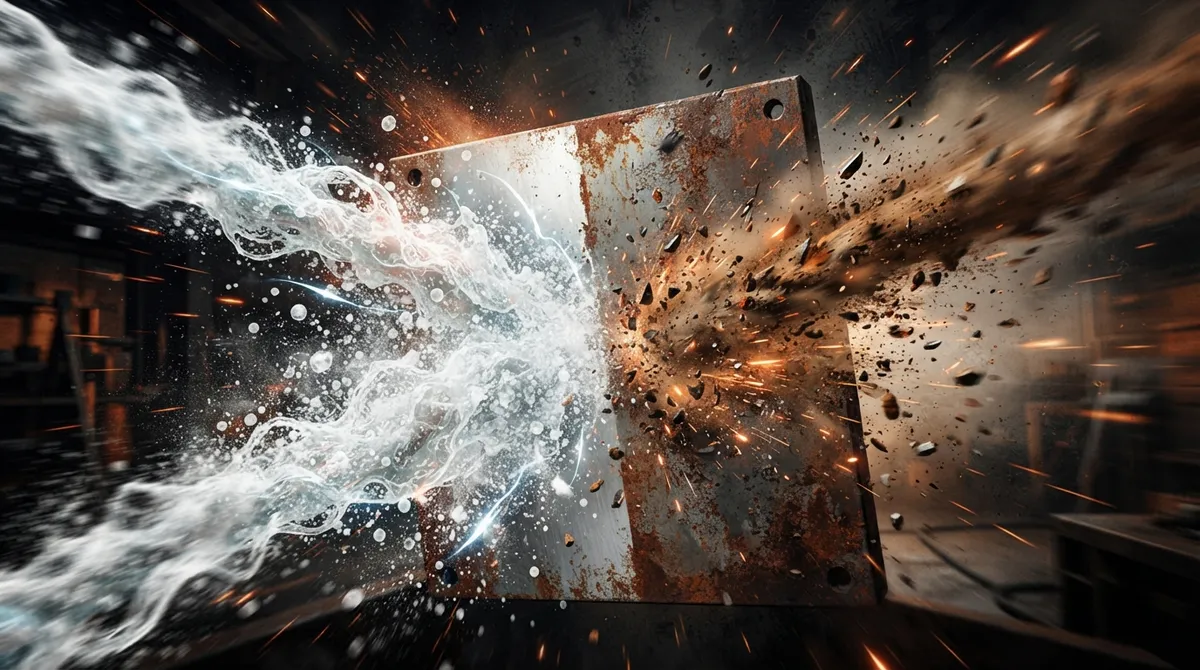
Let’s clear up some confusion right away. In the mobile blasting world, “sandblasting” is often used as a catch-all term. Most professional crews don’t actually use silica sand anymore. Instead, they use abrasive media like crushed glass, garnet, aluminum oxide, or steel grit. We’ll explain why in a bit, but just know that when people say “sandblasting,” they usually mean abrasive blasting in general.
Soda blasting is different. It uses sodium bicarbonate, the same stuff in your kitchen’s baking soda box, just in a coarser form. This media is soft and water-soluble. It’s gentle enough to strip paint without chewing into the material underneath.
Here’s a simple breakdown of the two approaches:
- Soda blasting uses soft, gentle particles that dissolve in water
- Abrasive blasting (often called sandblasting) uses harder minerals or metal grit
- Soda is friable, meaning it breaks apart on impact instead of digging in
- Abrasive media cuts more aggressively into surfaces
- Soda works best on delicate items; abrasive media handles heavy-duty jobs
Why Real Silica Sand Isn’t Used Anymore
You might wonder why professional crews avoid literal sand. The answer comes down to health and safety. Breathing in fine silica dust over time can cause silicosis, a serious lung disease. This isn’t new information either. NIOSH has warned about this risk since 1974, recommending against using sand with more than trace amounts of free silica for blasting work.
OSHA backs this up with strict rules. The permissible exposure limit for respirable crystalline silica sits at 50 micrograms per cubic meter of air, averaged over an 8-hour workday. That’s an 80% drop from the old limit of roughly 250 micrograms. There’s also an action level of 25 micrograms that can trigger extra safety requirements. You can read more about what is sandblasting and its history if you want the full technical picture.
Because of these risks, responsible mobile blasting companies use silica-free alternatives. It’s safer for the crew, safer for anyone nearby, and honestly, it just makes sense.
When Soda Blasting Is Your Best Friend
Soda blasting shines in situations where you need to remove something without damaging what’s underneath. Think of it like using a soft eraser instead of sandpaper. Here are the top scenarios where soda blasting wins:
- Automotive restoration where thin body panels could warp under heavy abrasives
- Fire and smoke damage cleanup, since soda neutralizes odors too
- Graffiti removal from brick, stucco, or painted surfaces
- Food processing equipment that needs a food-safe, non-toxic media
- Fiberglass boat hulls where gouging the gelcoat would ruin the finish
- Delicate wood surfaces like trim, siding, or furniture
We get calls all the time from Tampa homeowners dealing with graffiti on a fence or a pool deck stained from years of buildup. Soda blasting handles these jobs beautifully because it lifts the mess without tearing up the material underneath. If you’re curious how this plays out on a real property, check out our post on why soda blasting is Tampa’s gentlest cleaning fix.
The Cleanup Advantage
One perk of soda blasting is that sodium bicarbonate dissolves in water. This makes rinse-off and cleanup simpler compared to insoluble media. That said, you still need to collect the removed paint, contaminants, and wastewater properly. Cleanup is easier, not effortless.
When You Need Stronger Abrasive Blasting
Now let’s talk about the jobs where soda just won’t cut it. If you’re dealing with heavy rust, thick mill scale, or old industrial coatings, you need something with more bite. This is where garnet, aluminum oxide, crushed glass, steel grit, or coal slag come into play.
These tougher media types are ideal for:
- Structural steel prep before repainting
- Heavy rust removal on trailers, equipment, or fencing
- Creating a surface profile so new coatings actually bond
- Stripping thick, multi-layer industrial coatings
- Marine hardware and metal boat trailers
- Concrete surface prep before resurfacing
Here’s an important technical point. Soda blasting generally doesn’t create a meaningful “anchor profile” on steel. That rough texture is what helps new paint or coating grip the metal. Without it, coatings can peel prematurely. So if you’re prepping steel for a fresh coat, a stronger abrasive blast is usually necessary, sometimes as a follow-up step after an initial soda pass.
Side-by-Side Comparison Table
| Factor | Soda Blasting | Abrasive Blasting (Sandblasting) |
|---|---|---|
| Media hardness | Soft, friable | Hard, aggressive |
| Best for | Paint, grease, soot, light corrosion | Heavy rust, mill scale, thick coatings |
| Surface profile created | Little to none | Yes, ideal for repainting |
| Risk to delicate substrates | Low | Higher if not adjusted |
| Cleanup | Water-soluble, easier rinse | Insoluble, requires collection |
| Common uses | Auto restoration, fire remediation, fiberglass | Structural steel, industrial equipment, marine hardware |
How to Decide: A Simple Step-by-Step Process
Choosing between soda blasting vs sandblasting doesn’t have to feel overwhelming. Here’s the process we walk through with every customer:
- Identify the substrate. Is it metal, wood, fiberglass, brick, or concrete?
- Determine what needs to come off. Light paint and grime, or heavy rust and old coatings?
- Decide if the surface will be repainted or recoated afterward.
- Check for delicate features nearby, like glass, landscaping, or trim.
- Test blast a small area to see how the surface responds.
- Match the media and pressure to the job, not the other way around.
This last point matters a lot. Blastworx has built a reputation around this exact philosophy: we match the blast to your surface, not the other way around. Every project gets evaluated before we ever fire up the equipment.
Surfaces That Need Extra Caution
Some materials require careful handling no matter which media you choose. These include:
- Soft metals like aluminum, which can warp or pit under high pressure
- Wood, which can splinter or fuzz if pressure isn’t dialed in correctly
- Fiberglass, which scratches easily and needs gentler media
- Masonry and brick, which can crumble if blasted too aggressively
- Painted surfaces where you want to remove paint without damaging the base material
This is exactly why test-blasting a small, hidden area is so important. It’s a five-minute step that can prevent a costly mistake.
Safety Considerations for Any Blasting Job
Neither soda blasting nor abrasive blasting is completely risk-free. Dust control matters in both cases. Even soda blasting kicks up dust, and depending on what’s being removed (old lead paint, for example), that dust can carry hazards of its own.
A professional crew should always:
- Use proper respiratory protection and PPE for the crew
- Contain dust and debris to protect the surrounding property
- Follow OSHA guidelines under 29 CFR 1910.134 for respiratory protection
- Assess what’s being removed, since old coatings can contain hazardous materials
- Set up ventilation or containment per 29 CFR 1910.94 when working indoors
At Blastworx, we protect the surrounding area on every job, whether we’re working dockside, in a driveway, or on a commercial job site. We’re fully mobile and self-contained, so we bring everything we need without tapping into your power or water.
Real-World Applications Across Industries
The soda blasting vs sandblasting decision plays out differently depending on the type of project. Here’s how it breaks down across common categories we handle:
| Project Type | Typical Media Choice | Why |
|---|---|---|
| Boat hulls and fiberglass | Soda or walnut shell | Protects gelcoat from gouging |
| Metal trailers and hardware | Stronger abrasives | Handles heavy rust and corrosion |
| Classic car restoration | Mix, depending on panel thickness | Prevents warping on thin metal |
| Structural steel | Garnet or steel grit | Creates profile for coating adhesion |
| Pool decks and pavers | Soda or lower-pressure abrasive | Removes buildup without cracking concrete |
| Wrought iron fences and gates | Abrasive media | Strips rust down to bare metal |
If you’re dealing with marine equipment, our marine blasting services use the right media for hulls, trailers, and hardware. For car projects, our automotive blasting page covers frames, panels, and full restorations. And if you’re working on something around the house, our residential blasting services cover fences, pool decks, and outdoor furniture.
Common Mistakes to Avoid
We’ve seen a few missteps trip up folks who try to DIY this decision. Here’s what to watch for:
- Using the wrong media for a delicate surface, causing permanent damage
- Skipping the test-blast step and finding out too late that pressure was too high
- Assuming soda blasting alone prepares steel for repainting
- Not accounting for hazardous materials in old coatings before blasting
- Choosing a media based on cost alone instead of the project’s actual needs
Avoiding these mistakes usually comes down to one thing: getting an expert opinion before you start. That’s true whether you’re handling a small home project or a large commercial job.
Why Working With a Mobile Blasting Team Makes Sense
One of the biggest advantages of hiring a mobile crew is flexibility. We come to you, whether that’s a shop in Tampa, a dock in Clearwater, or a job site out in Ocala. There’s no need to haul heavy equipment or vehicles to a shop. We show up fully equipped and ready to work.
Our process is straightforward:
- We do a walkthrough or review photos to determine the right media
- We provide a free, same-day written estimate
- We protect the surrounding area, then blast the surface on-site
- Your surface comes out clean and ready for the next step
Curious what other Tampa Bay residents think about working with us? You can see what our customers are saying about us on Google. We’re proud of the relationships we’ve built across the region, and we take that trust seriously on every job.
Wrapping It Up: Making the Right Call
So, soda blasting vs sandblasting: which one wins? The honest answer is that it depends entirely on your project. Soda is your gentle, precise option for delicate surfaces and situations where preserving the base material matters most. Abrasive blasting is the heavy hitter for rust, mill scale, and jobs that need a strong surface profile before recoating.
The real key is matching the media to the job, not forcing one method to handle everything. That’s exactly the approach we take on every project, whether it’s a boat hull, a rusty fence, or a commercial building facade. If you’re not sure which route fits your situation, we’re happy to take a look and walk you through it.
Ready to figure out the right approach for your surface? Get a free estimate today, or give us a call and let’s talk through your project. We serve Tampa, Clearwater, Sarasota, Ocala, Orlando, Fort Myers, and everywhere in between.
FAQs
Q: What is the difference between soda blasting and sandblasting?
A: Soda blasting uses soft sodium bicarbonate to gently lift paint and grime, while sandblasting (usually abrasive media, not real sand) uses harder materials for tougher jobs like rust and mill scale. Think of soda as the gentle option and abrasive blasting as the heavy-duty one. We’re happy to walk you through which fits your project best.
Q: Is soda blasting safer than sandblasting for workers and property?
A: Soda blasting is generally gentler on surfaces and creates less risk of gouging, but both methods require proper dust control and PPE. Neither is automatically risk-free, so a professional crew always takes precautions no matter which media is used. Safety always comes first on our jobs, whatever the method.
Q: Can soda blasting remove rust from metal?
A: Soda blasting handles light surface corrosion well, but it struggles with heavy rust or mill scale. For serious rust removal, a stronger abrasive like garnet or steel grit usually works better. We’ll take a look at your metal and recommend the right approach so you get lasting results.
Q: Does soda blasting create a surface profile for painting?
A: Not really. Soda blasting is too soft to create the rough texture, called an anchor profile, that helps new coatings grip metal properly. If you’re planning to repaint or recoat steel, you’ll likely need a more aggressive abrasive blast either instead of or after the soda pass.
Q: Can soda blasting damage aluminum, wood, brick, or fiberglass?
A: Soda blasting is one of the gentler options for these materials, but damage can still happen if pressure isn’t adjusted correctly. That’s why we always recommend a small test area before full production. It only takes a few minutes and saves you from any surprises later.





