
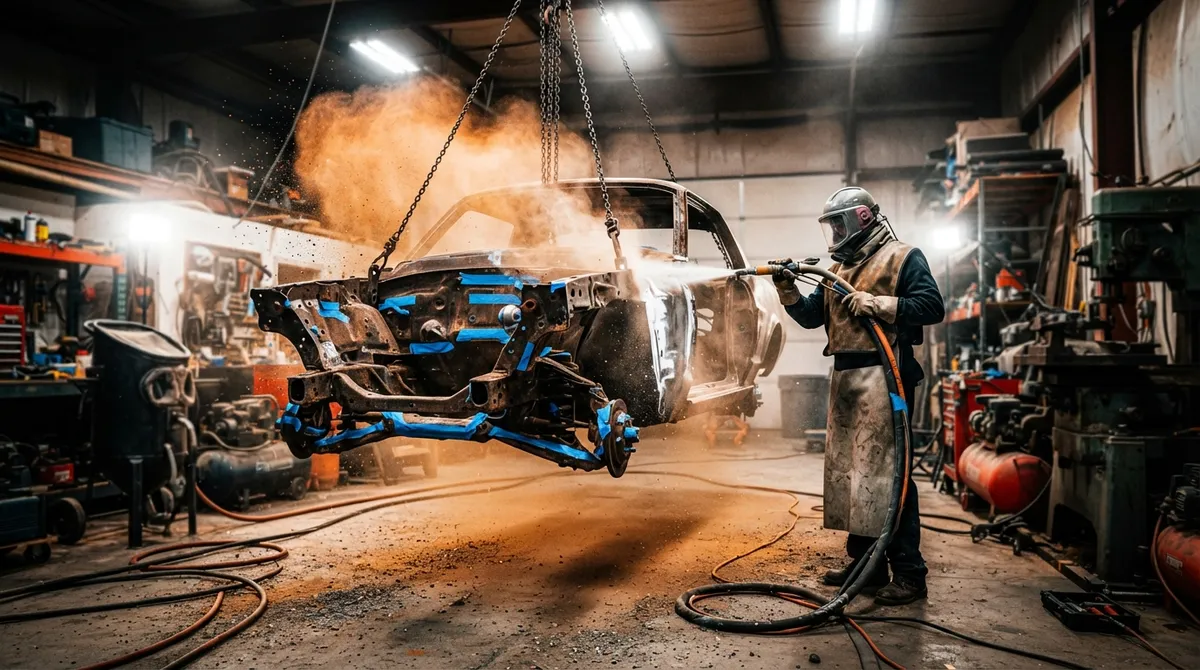
Key Takeaways
-
Modern automotive sandblasting uses specialized abrasive media like garnet, crushed glass, or soda blasting instead of silica sand, with the choice depending on metal thickness and coating type to avoid surface damage.
-
Mobile blasting eliminates transportation hassles by bringing fully self-contained equipment to your location, making it ideal for heavy frames, unroadworthy vehicles, and projects where hauling costs would be prohibitive.
-
Bare steel must be primed within hours after blasting to prevent flash rust in humid conditions like Florida’s; plan your coating strategy before the job starts to avoid delays.
-
Proper pre-blasting protection of sensitive components like wiring, seals, bearings, and trim is critical, along with pressure adjustments for different metal thicknesses, to prevent warping and contamination.
-
Wet blasting works better for tight spaces and indoor work with minimal dust, while dry blasting is faster and creates surface profiles that improve paint adhesion on heavy rust and thick coatings.
-
Pricing varies significantly based on vehicle size, rust severity, media type, and travel distance; always request an on-site inspection or free estimate rather than relying on generic quotes for accuracy.
So you’ve got a rusty frame, a crusty old fender, or a whole classic car project sitting under a tarp. You’re wondering if automotive sandblasting is the answer. Good news: it usually is. But there’s more to it than just pointing a nozzle and blasting away. The wrong media or too much pressure can warp a thin panel or push grit into places you’ll be digging out for months. That’s why folks across Tampa Bay call in a mobile crew who knows how to match the blast to the metal.
We’re going to walk through five key facts about automotive sandblasting that every car owner, restorer, or shop manager in central Florida should know before booking a job. We’ll cover safety, media choices, cost factors, and what happens after the blasting is done. By the end, you’ll know exactly what to expect and what questions to ask. Let’s get into it.
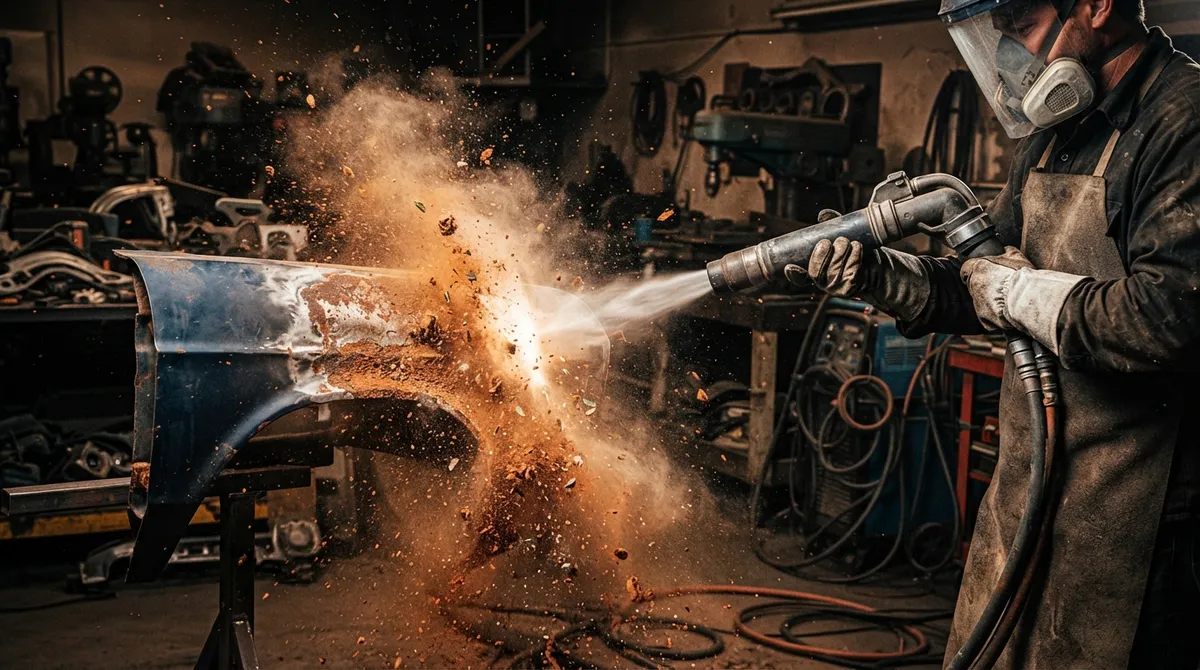
1. Automotive Sandblasting Is Really About Choosing the Right Abrasive
Here’s a fun fact: most “sandblasting” today doesn’t actually use sand. Old-school silica sand creates dangerous dust that can cause serious lung disease over time. Professional operators have moved on to safer, smarter media options instead.
The abrasive you pick depends on the metal, the coating, and how careful you need to be with the surface underneath. A frame covered in decades of rust needs something tougher than a thin fender that dents if you look at it wrong. This is where experience really pays off.
Common Abrasives Used in Automotive Blasting
- Crushed glass or recycled glass, good for general paint and rust removal
- Garnet, a sharp, fast-cutting media for heavy corrosion
- Soda blasting media, gentle enough for delicate panels and trim
- Steel shot, often used on thicker frames and heavy-duty parts
- Walnut shells or plastic media, ideal for softer substrates
A good mobile blasting outfit will walk the vehicle with you first and explain which media fits your project. That’s part of what we mean when we say we match the blast to your surface, not the other way around.
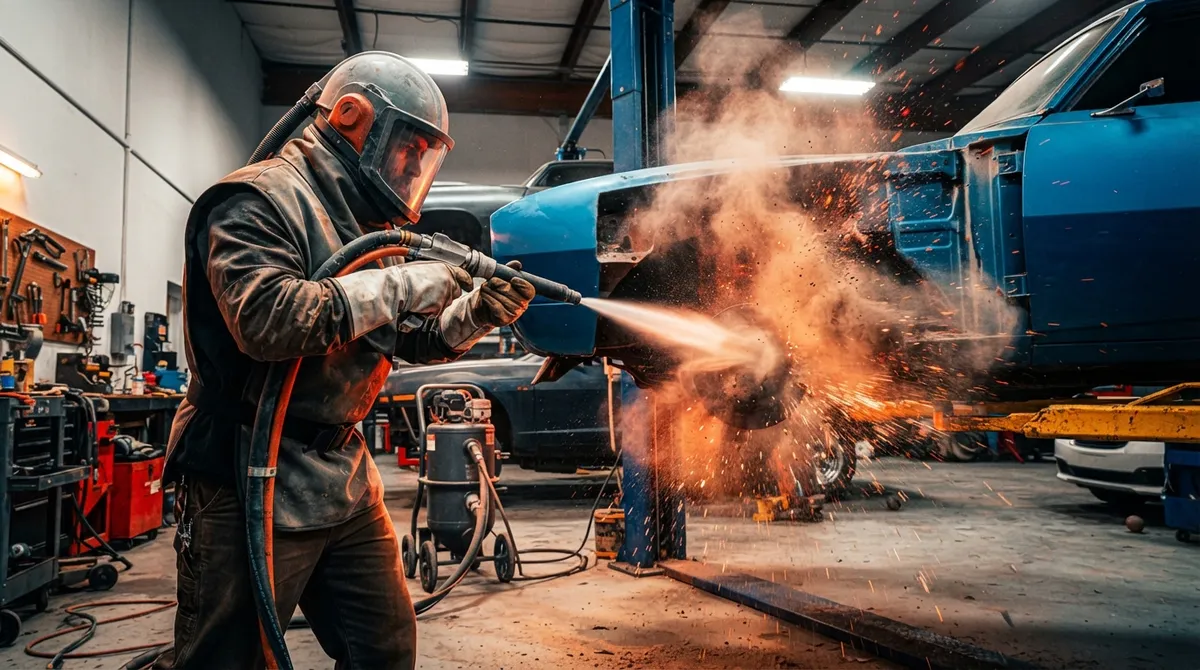
2. Mobile Blasting Saves You the Headache of Moving the Vehicle
Not every project can be trailered to a shop. Farm equipment, oversized trailers, and full vehicle frames are heavy, awkward, and sometimes just not roadworthy. That’s exactly why mobile automotive sandblasting exists.
Instead of hauling your project across town, the equipment comes to you. We come to you, whether that’s a driveway in Riverview, a shop in Brandon, or a barn out near Plant City. The rig is fully mobile and self-contained, so no power or water hookup is needed on your end.
Situations Where Mobile Blasting Makes the Most Sense
- Classic car restorations where the vehicle isn’t drivable
- Fleet vehicles and commercial trailers that are hard to schedule downtime for
- Farm and heavy equipment too large for a standard shop bay
- Multiple parts spread across a garage or job site
- Projects where transport costs would outweigh the blasting cost itself
If you’re not sure whether your project qualifies, it’s worth reaching out. Many owners across our service areas are surprised how much easier the process is when the crew comes to them.
3. Wet Blasting and Dry Blasting Each Have Their Place
One question we hear a lot is whether wet or dry blasting is better for a car project. The honest answer is, it depends on the job. Wet blasting, sometimes called dustless blasting, mixes water into the media stream to knock down dust and reduce heat.
Dry blasting tends to work faster and can leave a rougher surface profile, which some primers and coatings actually need for good adhesion. The choice comes down to the vehicle’s material, the coating being removed, and the site conditions.
| Method | Best For | Dust Level | Speed |
|---|---|---|---|
| Dry Blasting | Heavy rust, thick coatings, frames | Higher | Faster |
| Wet/Dustless Blasting | Thin panels, indoor or tight spaces, neighborhoods | Very Low | Slightly Slower |
To learn more about how the two methods compare in practice, check out this breakdown on wet sandblasting versus dry blasting. And if you want a deeper dive into what makes dustless technology so popular around Tampa, this article on what makes dustless blasting so effective is worth a read.
4. Protecting the Vehicle Matters as Much as the Blasting Itself
Blasting is powerful. That’s the whole point. But that same power can warp thin body panels, chew up wiring, or force grit into bearings and door cavities if things aren’t handled carefully. A rushed job can cause more problems than it solves.
This is why a proper inspection and masking process comes before any blasting starts. Sensitive parts should be removed or protected, and pressure should be adjusted section by section based on the metal thickness.
Parts That Often Need Removal or Protection
- Glass, mirrors, and lighting components
- Rubber seals, gaskets, and weatherstripping
- Wiring harnesses and electrical connectors
- Bearings, hinges, and moving mechanical parts
- Trim pieces and badges that could be damaged or lost
According to OSHA’s guidance on abrasive blasting safety standards, proper equipment, ventilation, and protective procedures are essential parts of any professional blasting operation, not just an afterthought. We’re fully insured and follow these practices as a matter of course, because doing it right the first time saves everyone a headache later.
5. What Happens After Blasting Is Just as Important
Here’s something a lot of folks don’t think about until it’s too late: bare steel doesn’t stay bare for long. Once the coatings and rust are gone, that metal is exposed and vulnerable to flash rust, sometimes within hours in Florida’s humidity.
That’s why timing matters so much after a blast job. The surface should be cleaned thoroughly, checked for any leftover contamination, and primed as soon as practical with a corrosion-inhibiting primer.
Steps for a Clean Finish After Blasting
- Inspect the surface closely for remaining rust or debris
- Blow off or vacuum any leftover media and dust
- Wipe down with an approved solvent if needed
- Apply primer promptly to prevent flash rust
- Confirm the primer is compatible with your final paint or coating
We’re mostly a strip-and-prep operation on the automotive side, though limited paint or sealer options may be available depending on the project. Either way, the surface leaves our hands back to clean, bare metal and ready for the next step, whether that’s your painter, your body shop, or your own garage project.
How Much Does Mobile Automotive Sandblasting Cost?
This is probably the question we get asked the most, and honestly, there’s no simple flat rate that applies to every job. Pricing depends on a handful of factors that vary from project to project.
| Factor | Why It Affects Price |
|---|---|
| Size of vehicle or part | Larger surface area takes more time and media |
| Coating thickness and type | Multiple layers or lead paint require extra care |
| Corrosion severity | Heavy rust needs more aggressive blasting |
| Media selected | Some abrasives cost more per pound than others |
| Travel distance | Farther job sites may include a travel fee |
| Cleanup and disposal | Spent media must be collected and disposed of properly |
Because there are so many variables, an on-site inspection or photo review gives a much more accurate number than a generic quote ever could. We offer a free, same-day estimate, and the price we give is the price you pay. For more detail on what affects pricing across different blasting jobs, this guide on how much sandblasting estimates really cost breaks it down nicely.
Safety and Regulations You Should Know About
Automotive sandblasting isn’t just about elbow grease and equipment. There are real safety and environmental rules that responsible operators follow, especially when dealing with older vehicles that might have lead-based paint.
- OSHA’s general industry standard 29 CFR 1910.94(a) covers ventilation, respiratory protection, and silica exposure controls
- The EPA identifies abrasive blasting as a dust-generating activity requiring containment in certain lead-paint situations
- Local air-quality and disposal rules may require permits depending on your county or project size
- Spent abrasive and paint chips must be collected and disposed of according to local regulations
If you’re working on a vehicle built before 1978, it’s worth asking your blasting contractor how they handle potential lead paint. A trustworthy crew will have a plan for containment and safe disposal rather than just blasting and hoping for the best. You can read more general background on the process itself through this overview of what is sandblasting if you want the full technical picture.
Choosing the Right Mobile Blasting Partner
Not every blasting company is set up for delicate automotive work. It takes a different touch than stripping paint off a warehouse beam or a concrete driveway. When you’re vetting a provider, here’s what to look for:
- Experience specifically with automotive frames, panels, and parts
- A clear explanation of which media they’ll use and why
- Proper containment and dust control for your location
- Insurance coverage and transparent, written estimates
- A plan for post-blast priming or handoff to your painter
We’ve built our reputation across Tampa, Clearwater, Sarasota, Ocala, Orlando, and Fort Myers by sticking to a simple process: walkthrough, free estimate, blast and strip, then hand the surface back ready to finish. You talk to the people doing the work, every step of the way. Curious what that looks like in practice? Take a look at our project gallery or browse our automotive blasting services page for more detail.
We’re proud of the relationships we’ve built with restoration shops, mechanics, and weekend project owners throughout central Florida. You can visit us on Google and see what our customers are saying about us if you want to hear it straight from folks who’ve had their frames, fenders, and classic cars brought back to bare metal.
Ready to Get That Rust Off Your Ride?
Automotive sandblasting done right can save a project that seemed hopeless, whether it’s a frame buried in decades of rust or a fender with more filler than steel left. The key is picking a crew that understands metal, media, and mess control equally well. That’s exactly what we bring to every job across the Tampa Bay area and beyond.
If you’ve got a vehicle, frame, or set of parts that need to go back to clean, sound metal, we’d love to take a look. Get a free estimate today, or if you’d rather talk it through first, give us a call and we’ll walk you through exactly what your project needs.
FAQs
Q: What is automotive sandblasting and how does mobile blasting work?
A: Automotive sandblasting removes paint, rust, and old coatings from vehicle bodies, frames, and parts using pressurized abrasive media. With mobile blasting, we bring our fully self-contained rig right to your driveway, shop, or job site, so you never have to worry about hauling a heavy or unroadworthy vehicle anywhere.
Q: How much does mobile automotive sandblasting cost?
A: Honestly, there’s no one-size-fits-all price since it depends on vehicle size, rust severity, media choice, and cleanup needs. The good news is we offer a free, same-day estimate after a quick walkthrough or photo review, so you’ll know exactly what to expect before we start.
Q: Will sandblasting warp thin body panels on my car?
A: It can if the wrong pressure or media is used, which is why we always match the blast to your surface rather than using a one-size-fits-all approach. Thin panels get lower pressure and gentler media, while heavy frames can handle something tougher.
Q: How soon should a car be primed after sandblasting?
A: As soon as practical, ideally the same day, since bare steel can start developing flash rust quickly in Florida’s humidity. We recommend having your primer or coating plan ready before blasting begins so there’s no delay once the surface is clean.
Q: Can mobile blasting remove lead-based paint from an older vehicle?
A: Yes, but it takes extra care and proper containment since lead paint dust can be hazardous if not handled correctly. If you’re working on a pre-1978 vehicle, just let us know upfront so we can plan the right safety measures from the start.





