
Key Takeaways
-
Poor surface preparation directly causes early coating failure within years; proper SSPC-SP6 or SSPC-SP10 blast cleaning standards ensure coatings last 25+ years instead of just 5 years.
-
Abrasive blasting must achieve the correct surface profile (1.5-2.5 mils depth) and blast pressure (minimum 620 kPa) with real-time gauge checks throughout the job to ensure paint adhesion consistency.
-
A secondary dust and residue cleaning step using HEPA vacuums or oil-free compressed air is mandatory after blasting, as fine particles left behind will interfere with coating adhesion even after thorough blast cleaning.
-
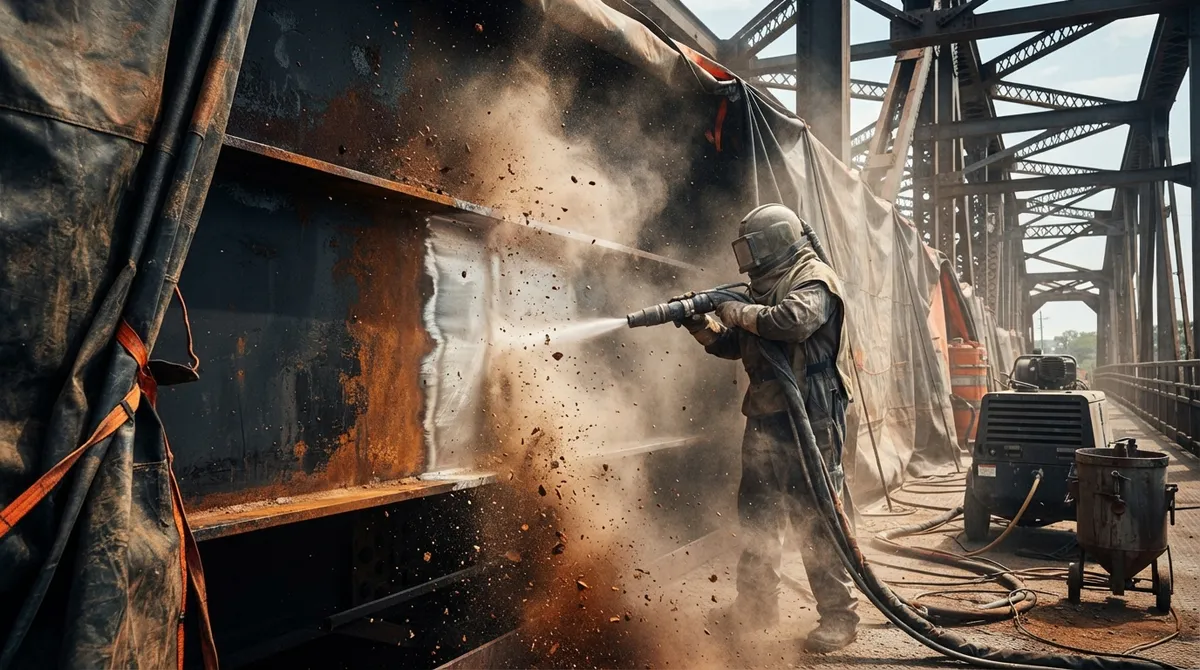
Mobile blasting equipment must come on-site to bridges since structures cannot be transported; containment systems capture dust and spent abrasive directly at the source during preparation.
-
All contaminants including oil, grease, salt deposits, rust, loose paint, mill scale, and weld slag must be completely removed before painting, as any residue interferes with adhesion and causes premature failure.
-
Less aggressive prep methods like water washing or power tool cleaning are viable for preventive maintenance when budgets are tight, but full abrasive blasting remains necessary for complete rust and coating removal.
Bridges take a beating. Sun, rain, salt air, and years of traffic all leave their mark. Before any fresh coat of paint goes on, the old rust, grime, and failing coatings have to come off completely. That’s where bridge painting preparation comes in, and it’s honestly the step that decides whether a paint job lasts five years or twenty-five.
If you’ve ever wondered why bridge maintenance crews spend so much time on prep before a single drop of paint touches the steel, you’re in the right place. We’ll walk through what proper preparation looks like, why abrasive blasting is usually the go-to method, and how mobile blasting makes this kind of work possible on a structure that simply can’t be moved to a shop. Grab a coffee, and let’s get into it.
Why Surface Prep Makes or Breaks a Bridge Coating
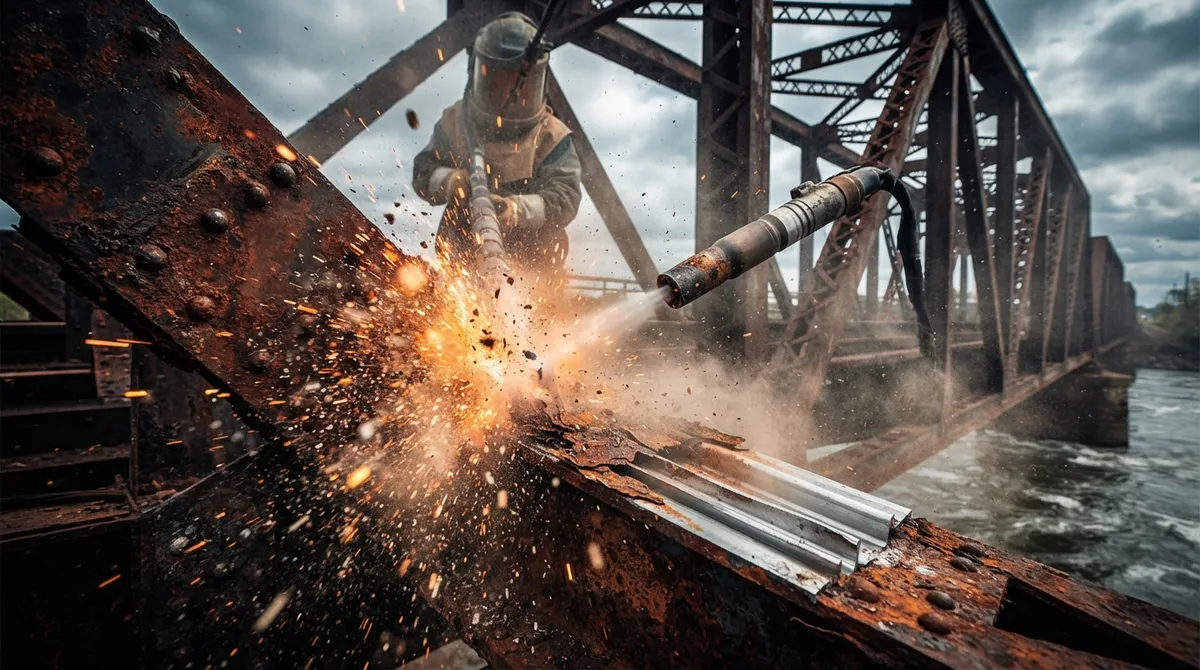
Here’s the honest truth: paint doesn’t stick well to rust, grime, or old flaking coatings. It just doesn’t. Every bridge maintenance manual out there says the same thing. The surface has to be clean and properly roughened, or the new coating will fail early, sometimes within a couple of years.
Think of it like painting a wall. If you paint over dust, cobwebs, and peeling wallpaper, that new paint is going to bubble and peel fast. A bridge is the same idea, just on a much bigger and tougher scale. Steel and concrete need a clean, sound base before anything else happens.
- Poor prep leads to early rust breakthrough and coating failure
- Good prep extends coating life by years, sometimes decades
- Agencies write strict prep standards into bridge contracts for this exact reason
- Skipping steps almost always costs more in the long run
What Bridge Painting Preparation Actually Involves
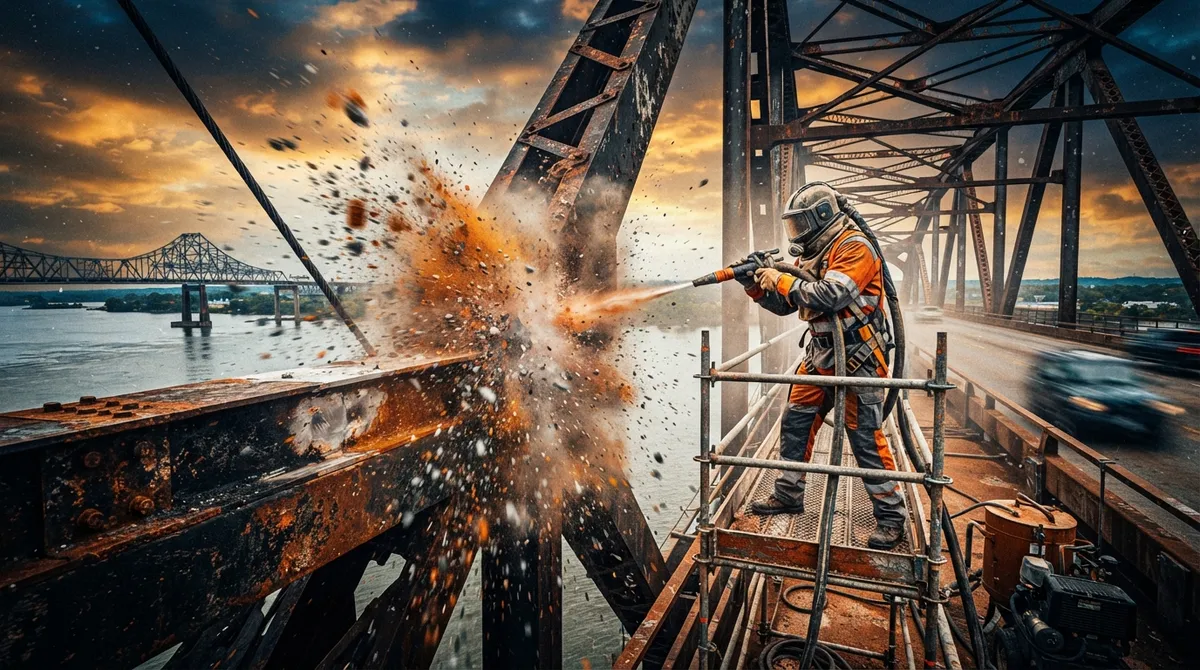
Bridge prep isn’t just a quick wipe-down. It’s a multi-stage process designed to strip away everything that could interfere with paint adhesion. That includes oil, grease, dirt, salt deposits, rust, loose paint, mill scale, and even leftover weld slag from fabrication or repair work.
Most bridge specifications call for dry abrasive blast cleaning, and the standard used depends on how aggressive the job needs to be. You’ll often see references to SSPC-SP6 (commercial blast cleaning) or SSPC-SP10 (near-white blast cleaning), depending on the exposure conditions and coating system planned for the structure.
Contaminants That Must Be Removed Before Painting
- Oil and grease from equipment or vehicle exposure
- Dirt, dust, and general road grime
- Salt deposits, especially critical near coastal bridges
- Rust and corrosion products
- Loose or failing old paint layers
- Mill scale left over from steel manufacturing
- Weld slag from fabrication or field repairs
Once blasting removes all of that, the surface still isn’t quite ready. Dust and blast residue left behind need to be cleaned again, usually with dry, oil-free compressed air or HEPA vacuum systems. Skipping this second cleaning step can leave fine particles that interfere with coating adhesion, even after a thorough blast.
SSPC Standards Used in Bridge Blast Cleaning
If you’re new to this world, all the acronyms can feel like alphabet soup. Let’s break it down simply. SSPC stands for the Society for Protective Coatings, and their standards describe exactly how clean a blasted surface needs to be before painting.
| Standard | Common Name | Cleanliness Requirement |
|---|---|---|
| SSPC-SP6 | Commercial Blast Cleaning | At least two-thirds of each area free of visible residue |
| SSPC-SP10 | Near-White Blast Cleaning | At least 95% of each 150-cm² area free of visible residue |
These numbers aren’t arbitrary. The FHWA field manual spells out these percentages specifically so inspectors have a clear, measurable way to check the work. It’s not a matter of opinion, it’s a pass or fail standard based on visible surface condition.
Blast Pressure and Surface Profile Requirements
Getting the right level of cleanliness is only part of the equation. The surface also needs the right texture, called a surface profile, so the primer has something to grip onto. Think of it like sanding wood before staining; too smooth and the stain won’t take.
- One bridge painting manual requires blast pressure of at least 620 kPa (90 psi)
- A common surface profile target is 1.5 to 2.5 mils (25 to 50 µm)
- Too shallow a profile weakens paint adhesion
- Too deep a profile can leave peaks exposed above the coating film
Getting this balance right takes experience. It’s not something you eyeball once and move on from; crews typically check profile depth with gauges throughout the job to keep everything consistent across the whole structure.
Why Mobile Blasting Is the Standard for Bridge Work
Here’s the thing about bridges: they don’t fit in a truck bed. You can’t haul a 200-foot span into a blasting shop, blast it, and haul it back. The structure has to be prepped exactly where it stands, which is why mobile blasting has become the practical standard for most bridge maintenance projects.
Mobile rigs bring the equipment, containment, and abrasive media directly to the site. This is the same principle behind a lot of the on-site work we do at Blastworx, just applied at a bridge scale. Whether it’s a dock piling, a fence, or a massive steel span, the structure stays put and the equipment comes to it.
Advantages of On-Site Bridge Blasting
- No need to dismantle or transport massive structural sections
- Containment systems capture dust and spent abrasive right at the source
- Crews can adjust blast pressure and media based on real conditions on site
- Inspection and quality checks happen in real time, not after a delay
- Work can often continue in phases without shutting down an entire structure
Common Bridge Prep Methods Beyond Full Abrasive Blasting
Not every bridge project calls for a full abrasive blast down to bare metal. Depending on the maintenance scope, budget, and environmental rules in place, crews sometimes use lighter methods instead.
| Method | Best Used For | Notes |
|---|---|---|
| Full Abrasive Blasting | Complete rust and coating removal | Most thorough, reaches SSPC-SP6 or SP10 levels |
| Vacuum Blasting | Contained areas needing dust control | Captures debris directly during blasting |
| Sweep Blasting | Light roughening of sound coatings | Doesn’t remove existing paint layers |
| Water Washing | Preventive maintenance cleaning | Removes dirt and salts, not rust or old paint |
| Power Tool Cleaning | Spot repairs and small areas | Feasible for touch-up work, slower for large areas |
Some bridge guidance actually points to water washing and power tool cleaning as the most practical preventive maintenance options for certain situations, especially when a full repaint isn’t in the budget yet. It’s about matching the method to the actual condition of the structure, not just defaulting to the most aggressive option every time.
How Dust and Debris Get Controlled During Blasting
Bridges are often near water, roads, or residential areas, so controlling dust and spent abrasive isn’t optional. It’s a core part of responsible bridge blasting work.
- Containment systems, like tarps or enclosures, catch abrasive and paint debris
- HEPA vacuum systems pull fine dust particles from the air and surface
- Dry, oil-free compressed air clears residue after blasting is complete
- Collected material is disposed of according to environmental regulations
This matters just as much on smaller commercial and industrial jobs. If you’ve read about structural steel blasting facts Florida owners need, you already know containment and cleanup aren’t afterthoughts, they’re part of doing the job right from the start.
Comparing Prep Quality: What Happens When Prep Is Rushed
Let’s be blunt for a second. A rushed prep job might look fine the day the paint goes on. But six months to a year later, problems start showing. Rust bleeds through, coatings bubble, and the whole project has to be redone, at a much higher cost than doing it right the first time.
A proper prep job, done to the correct SSPC standard with the right profile depth, sets the coating up to perform for its full expected lifespan. That’s the whole point of following these specifications so closely. It’s not bureaucracy for its own sake, it’s protecting a very expensive piece of infrastructure.
How This Connects to Broader Surface Prep Work
Bridge painting preparation is really just a large-scale version of principles used across all kinds of surface prep work. Whether it’s mobile blasting for industrial equipment or prepping a commercial building exterior, the same core idea applies: match the blasting method to the surface, remove everything that shouldn’t be there, and confirm the results before moving forward. If you’d like to understand the mechanics behind this process in more general terms, what is sandblasting offers a solid technical overview of abrasive blasting fundamentals.
At Blastworx, we bring that same mindset to every project across Tampa Bay and the central Florida corridor. We match the blast to your surface, not the other way around, whether that’s structural steel, concrete, or metal fencing. Our rig is fully mobile and self-contained, so we come to you and set up wherever the work needs to happen.
Why On-Site Blasting Makes Sense for Large Structures
Large fixed structures share a common challenge: they can’t be shipped off to a shop. This is true for bridges, and it’s true for plenty of other structures we work on regularly.
- Storage tanks and industrial vessels too large to transport
- Docks, pilings, and marine structures fixed in place
- Building exteriors and structural steel frameworks
- Large concrete surfaces like parking areas and sidewalks
If you’ve explored our Industrial or Marine services, you’ve seen this same on-site approach applied to different surfaces and industries. The principle stays consistent: we protect the surrounding area, contain the mess, and leave the surface ready for the next step.
What to Expect From a Professional Blasting Team
Whether it’s a bridge or a commercial building, a good crew follows a clear process. Here’s what that typically looks like from start to finish.
- Initial assessment of the surface and contamination level
- Selection of the right abrasive media and blast pressure
- Containment setup to control dust and debris
- Full blast cleaning to the required standard
- Secondary cleaning to remove dust and residue
- Inspection to confirm profile depth and cleanliness
This sequence isn’t random. Each step protects the next one, and skipping any of them risks the whole project’s outcome. It’s the same reason we walk every client through our own Home page process before starting work, so there are no surprises once the blasting begins.
Curious what past clients have experienced working with us? You can visit us on Google — see what our customers are saying about us before reaching out. We’re proud of the reputation we’ve built across Tampa and the surrounding areas, one job at a time.
Ready to Get Your Project Prepped Right?
Bridge painting preparation might be a specialized field, but the core lessons apply to almost any surface that needs a fresh start. Clean, properly profiled surfaces are the foundation of every lasting coating job, full stop. Rushing this step almost always costs more down the road.
If you’ve got a structure, whether it’s steel, concrete, or something else entirely, that needs professional surface prep, we’d love to talk it through with you. You can get a free estimate today, or if you’d rather talk it through first, feel free to give us a call. We’re based right here in Tampa Bay, and we serve the whole central Florida corridor, including Ocala, Orlando, and Fort Myers. For the right job, we’ll travel anywhere in the state. You talk to the people doing the work, every single time.
FAQs
Q: What is bridge painting preparation in mobile blasting?
A: It’s the process of cleaning and roughening a bridge’s steel or concrete surface before painting, usually with abrasive blasting done right on-site. Since bridges can’t be moved to a shop, mobile blasting crews bring the equipment to the structure and prep it in place, from removing rust to controlling dust.
Q: What surface prep standard is required for bridge painting?
A: Most bridge specs call for SSPC-SP6 or SSPC-SP10 blast cleaning, depending on how thorough the job needs to be. SP10 requires the surface to be at least 95% free of visible residue, while SP6 allows a bit more tolerance at two-thirds clean per area.
Q: Is abrasive blasting better than power tool cleaning for bridge steel?
A: For full rust and coating removal, abrasive blasting is generally more thorough and faster across large areas. Power tool cleaning has its place for smaller spot repairs, but it’s tough to match the consistency blasting provides on a whole span.
Q: How does mobile blasting help with bridge maintenance projects?
A: Bridges are massive and fixed in place, so they simply can’t be transported to a blasting facility. Mobile blasting brings containment, equipment, and the right abrasive media directly to the bridge, making on-site prep the practical and standard approach.
Q: What contaminants must be removed before painting a bridge?
A: Crews need to strip away oil, grease, dirt, salt deposits, rust, loose paint, mill scale, and weld slag. Every one of these can interfere with paint adhesion if it’s left behind, which is why thorough blasting followed by a dust cleanup matters so much.





