
Key Takeaways
-
Dustless blasting suppresses 90-95% of dust compared to traditional dry sandblasting, making it safe for open storefronts with proper containment and scheduling around business hours.
-
Most jurisdictions require permits, written notices to adjacent occupants, and compliance with visible emission limits (40% unconfined, 20% confined), which reputable mobile crews handle before work begins.
-
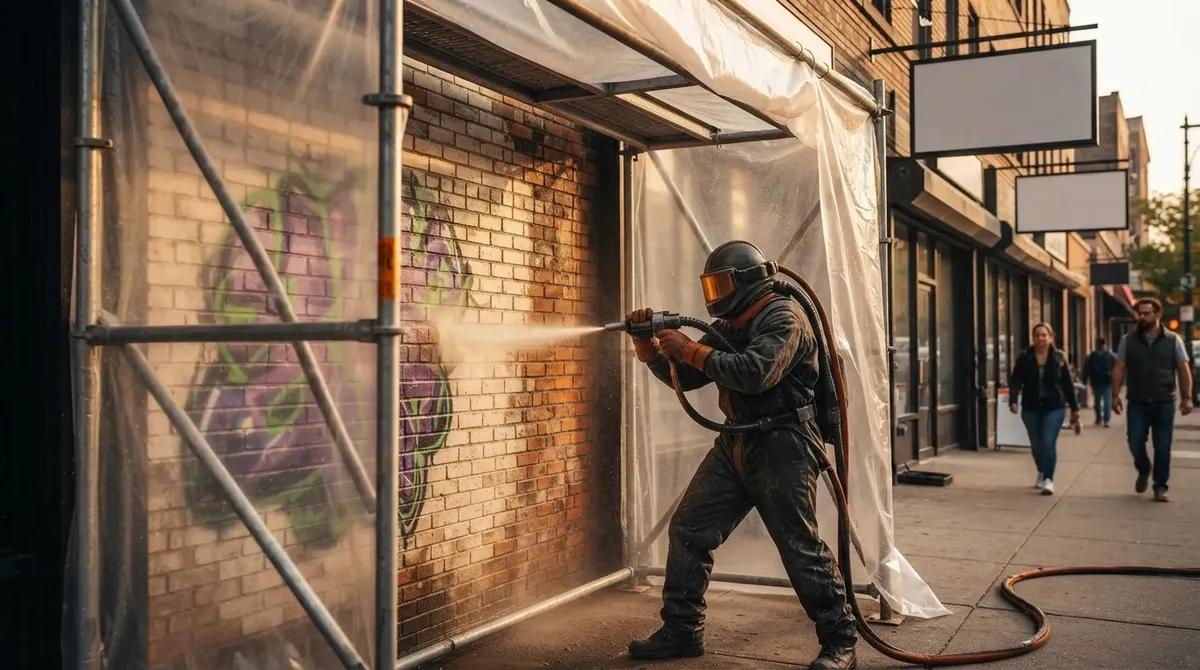
Proper containment using temporary screens, tarps, barricades, and wet suppression allows customers to pass by safely, eliminating the need for full closure and protecting your revenue.
-
Traditional dry sandblasting releases silica particles, paint chips, and rust flakes creating health hazards and liability risks, which is why it’s prohibited near open storefronts by safety codes.
-
Mobile blasting crews can schedule work during early mornings, evenings, weekends, or section-by-section to minimize disruption while keeping your doors open for business.
-
Different storefront surfaces require different blasting approaches: metal trim uses dustless methods, concrete uses sand blasting, painted masonry uses low-pressure soda blasting, and glass requires careful masking or exclusion.
Picture this: your storefront’s paint is peeling, there’s rust bleeding through the metal trim, and you’re wondering if you can get it fixed without shutting your doors. It’s a great question, and one we hear a lot from business owners across Tampa Bay. The short answer is that traditional dry sandblasting almost never works while a storefront stays open, but there’s good news. Modern dustless blasting methods make it possible to get your storefront looking sharp again without losing a single day of sales.
We’ve worked with plenty of shop owners who thought a full closure was their only option. It’s not. With the right approach, a little planning, and a mobile blasting crew that knows how to contain the mess, you can keep your doors open and your customers happy. Let’s walk through exactly how this works, what the rules say, and how to plan a project that fits your business hours instead of fighting against them.

Why Traditional Sandblasting and Open Storefronts Don’t Mix
Old-school dry sandblasting kicks up a huge cloud of dust. We’re talking about visible emissions that can hit 90% opacity or higher. That’s basically a wall of dust hanging in the air. No customer wants to walk through that, and honestly, no business owner wants that liability either.
The bigger issue is what’s actually in that dust. Depending on the surface, blasting can release silica particles, old paint chips, and rust flakes into the air. Silica dust is a serious health hazard, and it’s not something you want drifting into your lobby or onto your merchandise. That’s why what is sandblasting actually involves matters just as much as when and where you do it.
The Health and Safety Concerns Behind the Rules
Safety codes exist for good reason. Regulations typically require that a blasting work area be fully enclosed, or screened at least two meters above the structure, if full enclosure isn’t possible. This keeps dust from drifting onto sidewalks, parking lots, or into open doorways.
Here’s a quick breakdown of why these rules matter so much for storefronts specifically:
- Customers and employees can be exposed to airborne silica without realizing it
- Abrasive media can scratch glass windows, damage signage, or contaminate inventory
- Wind and foot traffic near an open door make containment nearly impossible with dry methods
- Liability increases significantly if someone outside the blast zone gets hurt or exposed
- Local fire and health departments may shut down a job that isn’t properly contained
None of this means your project is impossible. It just means you need the right method and the right team.
The Real Answer: Dustless Blasting Changes the Game
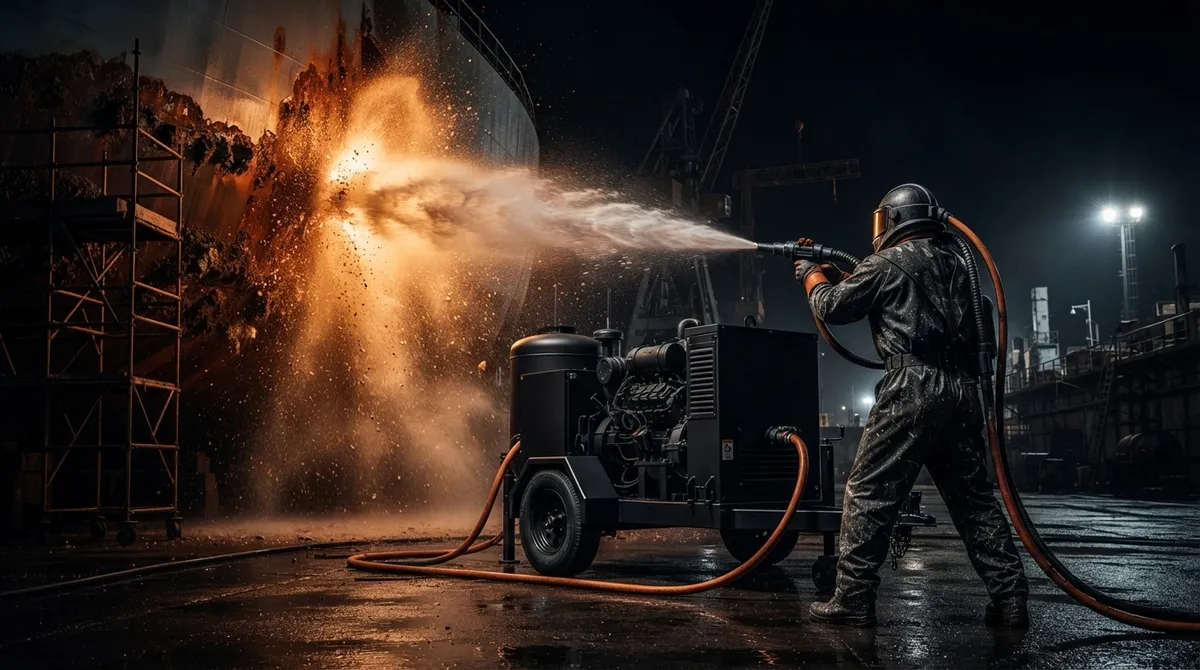
So can you sandblast a storefront while it’s open? With traditional dry blasting, not really. But with dustless, or wet, abrasive blasting, the answer changes quite a bit. Wet blasting introduces water into the media stream, which suppresses somewhere between 90 and 95% of the dust compared to dry blasting.
That’s a massive difference. It means less airborne silica, better visibility, and a much safer environment for anyone nearby. This is exactly why so many commercial property owners now ask specifically for dustless blasting when working near active businesses.
How Dustless Blasting Makes Open-Storefront Work Possible
Here’s what makes this method so much more practical for busy commercial corridors:
- Water suppresses dust at the point of impact, so it never becomes airborne in large quantities
- Lower visible emissions mean you stay well under opacity limits required by most jurisdictions
- Cooler blasting temperatures reduce the risk of warping thin metal storefront trim
- Cleanup is faster since wet debris doesn’t scatter the way dry dust does
- Crews can work closer to entrances without triggering the same exclusion zone requirements
We match the blast to your surface, not the other way around, and that’s especially true on storefronts where glass, signage, and stucco all need different care.
Permits, Notices, and Legal Requirements You Should Know
Before any storefront blasting begins, there’s usually some paperwork involved. Requirements vary by city, but a few patterns show up again and again.
| Requirement | Typical Standard |
|---|---|
| Permit for outdoor abrasive blasting | Often required before work begins |
| Written notice to adjacent occupants | Three days’ notice is common in many cities |
| Allowed working hours | Usually prohibited before 7 a.m. or after 7 p.m., with some exceptions for Sundays and holidays |
| Visible emission limits (unconfined) | Capped at 40% opacity |
| Visible emission limits (confined) | Capped at 20% opacity |
A reputable mobile blasting crew will handle these details for you, but it’s smart to ask upfront. If you’re planning work in a shopping center or downtown corridor, check with your city’s building or environmental department first.
Containment: The Key to Keeping Your Doors Open
Even with dustless methods, containment is what really makes open-storefront blasting safe and practical. Mobile blasting lacks the built-in walls of an indoor facility, so crews have to bring their own barriers to the job.
Here’s what proper containment usually looks like on a storefront job:
- Temporary screens or tarps set up around the work zone
- Barricades and clear signage to redirect foot traffic away from the blast area
- Protective covering over windows, doors, and any exposed merchandise displays
- Wet suppression to knock down dust before it spreads past the containment area
- PPE for the crew, including respirators and eye protection, even with wet methods
We contain the mess and protect the surrounding area on every job, which is really the whole point. Your customers should be able to walk past, or even walk in, without noticing much more than a little activity outside.
Scheduling Around Business Hours
Containment solves the safety problem, but timing solves the disruption problem. Most mobile blasting companies will happily schedule storefront work during evenings, weekends, or slower business periods.
Some smart scheduling strategies include:
- Early morning blasting before your doors officially open for the day
- Late evening sessions after closing, timed within local noise and hour restrictions
- Weekend work if your storefront sees less traffic on Saturdays or Sundays
- Section-by-section blasting so only one side of the entrance is affected at a time
- Coordinating with neighboring businesses if your storefront shares a wall or walkway
This kind of flexible scheduling is one reason Tampa businesses choose mobile sandblasting instead of trying to squeeze the work into a single closure day.
What Storefront Surfaces Can Actually Be Blasted?
Not every part of a storefront responds the same way to blasting. Here’s a simple breakdown of common surfaces and how they’re typically handled.
| Surface | Typical Approach | Notes |
|---|---|---|
| Metal awnings and trim | Soda or dustless blasting | Removes rust and old paint without warping thin metal |
| Concrete entryways | Sand or dustless blasting | Great for removing gum, grease, and old sealant |
| Painted stucco or masonry | Low-pressure soda blasting | Strips paint without damaging the substrate underneath |
| Glass storefront windows | Evaluated case by case | Requires careful masking or exclusion from the blast zone |
| Signage and metal letters | Dustless blasting | Cleans buildup while preserving fine details |
Some surfaces, like glass, veneer, and cultured stone, need an in-person evaluation before work starts. That’s just part of doing the job right.
Common Storefront Projects We See in Central Florida
Tampa Bay’s humidity and salt air are tough on storefronts. Over the years, we’ve handled plenty of jobs that fall into similar categories:
- Rust removal from metal support beams and awning frames
- Graffiti removal from side walls and rear entrances
- Paint stripping ahead of a fresh coat or rebrand
- Concrete cleaning for entryways and loading zones
- Buildup removal from HVAC housing units mounted near entrances
If graffiti is part of your storefront headache, you might find our guide on graffiti removal facts for Tampa property owners helpful too.
Step-by-Step: What to Expect From a Mobile Storefront Blasting Job
- Initial walkthrough or photo review to identify surfaces and plan the right media
- A written, same-day estimate so you know the price before work begins
- Permit and notice paperwork handled ahead of the scheduled date
- Setup of containment barriers, signage, and protective covering on-site
- Blasting performed using dustless or low-pressure methods suited to your storefront
- Final cleanup and inspection so the surface is ready for the next step
This process is pretty consistent whether you’re in downtown Tampa, Ocala, or Orlando. We come to you, fully mobile and self-contained, so there’s no need for you to provide power or water on-site.
Is It Worth Doing This Work Without Closing?
Closing for a day or two might feel simpler on paper, but for most retail and restaurant storefronts, lost revenue adds up fast. Dustless blasting with proper containment usually costs a little more in planning time, but it protects your bottom line in a way a full shutdown never will.
If you’re weighing your options, it helps to compare this approach against other prep methods too. Our breakdown of sandblasting versus pressure washing for concrete is a good place to start if part of your project involves entryway concrete.
Ready to Talk About Your Storefront?
Every storefront is a little different, and that’s exactly why we start every project with a walkthrough instead of guessing. We’ll figure out the right media for your surface, work around your hours, and protect everything nearby while we work. Curious what past customers thought about working with us? Feel free to visit us on Google and see what our customers are saying about us before you decide.
If you’re ready to get your storefront looking sharp without closing your doors, reach out today to get a free estimate, or simply give us a call to talk through your project. We proudly serve Tampa, Clearwater, Sarasota, Ocala, Orlando, Fort Myers, and communities throughout the central Florida corridor, and for the right job, we’ll travel just about anywhere in the state.
FAQs
Q: Can you sandblast a storefront while it’s open to customers?
A: With traditional dry blasting, it’s really not safe or practical to stay open. But with dustless blasting and proper containment, we can often work while your storefront stays open, especially if we schedule around your busiest hours.
Q: What is dustless sandblasting and how does it help with storefronts?
A: Dustless blasting mixes water into the abrasive media, which knocks down 90 to 95% of the dust compared to old-school dry blasting. That means less mess, less risk, and a much friendlier experience for your customers walking by.
Q: Do I need a permit to sandblast the outside of my business?
A: In most cities, yes, you’ll need a permit for outdoor abrasive blasting, and some places require a few days’ written notice to nearby businesses. We handle this paperwork for you so you don’t have to chase it down yourself.
Q: Is sandblasting safe for pedestrians walking by an open storefront?
A: It can be, as long as the crew sets up proper containment like screens, barricades, and signage. We always protect the surrounding area and keep foot traffic clear of the blast zone, so pedestrians stay safe while we work.
Q: What time of day is best for storefront sandblasting?
A: Early mornings before opening, evenings after closing, or slower weekend hours usually work best. We’re happy to plan around your schedule so the work gets done with as little disruption as possible.





